Work with Us

Infinite Recovery Project 2025

Guidance

Guidance, Professionals, Recovery

SURVIVING ADDICTION DOESN’T MAKE YOU AN EXPERT IN ADDICTION!

I spent 22 years in 12-step recovery and It helped me stop using drugs And for a long time, I thought that gave me something incredibly valuable when helping other people I knew what worked and I’d lived it I’d survived it and I’d seen other people survive it too So when someone was struggling, I could recognise what was happening Or at least I thought I could! Because there is a very small distance between This saved my life and This is what will save yours And we can cross it without ever noticing The same thing happens everywhere Someone transforms their life through the 12 Steps Someone discovers therapy Someone finds God Someone has an extraordinary experience with psychedelics Someone discovers trauma Someone finds meditation, breathwork, exercise, medication, a particular teacher or philosophy It changes everything And naturally, they want other people to experience what they’ve experienced The heart behind that can be completely genuine But passion is not proof Your transformation tells me something extraordinary about what was possible for you. It doesn’t tell me what another human being needs In fact, the more profound our own transformation was, the harder this may be to see Because now we don’t merely have an idea We have evidence that feels personal “I was dying and this saved me” “I tried everything until I found this” “I know because I’ve been there” And suddenly our experience isn’t informing our curiosity anymore It’s supplying the answer! We stop asking “What is happening for you?” and begin asking “How do I help you see what I already know?” That’s a completely different relationship I don’t think we need to throw away lived experience I think we need to become much more careful about the authority we give it Your recovery story can offer hope It can show someone what is possible It can create connection It can even save a life But it can never tell you who the person sitting in front of you is So… “Can I meet this person without needing their answer to look anything like mine?” Might be one of the hardest things any of us with lived experience ever learn to do

Guidance, Professionals, Recovery

TRAUMA DIDN’T CAUSE MY ADDICTION

Trauma mattered in my life But saying it caused my addiction now feels far too simple Plenty of people experience trauma and never become addicted And people who become addicted can have completely different histories So somewhere between what happened and what I eventually did, something else mattered How I experienced myself How I experienced the world What became unbearable What heroin changed for me From inside that experience, using made sense Calling trauma “the cause” can give us an answer too quickly The question I’m much more interested in is What made that behaviour necessary for me? Trauma may be part of that answer But it should never be allowed to end the inquiry

Guidance, Professionals, Recovery

Recovery models fail when they decide the answer, before understanding the person

Most recovery models begin with an explanation Disease Trauma Powerlessness Attachment Nervous system dysregulation Underlying pain Then the questions tend to follow the model And if we are not careful, the person’s answers get interpreted through the explanation we arrived with But look at the relief loop Life feels too much Something is used Relief happens Consequences follow Life becomes harder The cycle repeats The obvious temptation is to decide what the person really needs But that is exactly where inquiry has to begin What did this behaviour make possible for you? Not what do I think it gave you Not what my training says it must have been doing Not what happened for me when I was addicted For one person it may have created silence For another confidence For another belonging For another intensity For another escape from thinking For another something neither of us would have predicted That answer matters because the behaviour did not become necessary in a textbook It became necessary inside this person’s experience And that is why simply removing the substance can leave the whole organisation untouched The drug disappears The need does not Then we call what happens next relapse, self-sabotage, resistance or the disease But perhaps we never understood what the behaviour was solving in the first place A model can help us think It should never be allowed to answer for the person Recovery begins when we stop asking, Which model explains this? and start asking What became possible here that you could not find anywhere else? The answer has to come from the inquiry Not from us….

Guidance, Professionals, Recovery

THE DRUG WASN’T THE ADDICTION. IT WAS THE ANSWER (not to a disease!)

That may sound strange when the drug is destroying someone’s life But from inside their experience, it was doing something It changed how they felt It made something quieter Made something bearable Gave confidence, relief, belonging, intensity, escape, certainty, whatever that person needed at the time And that changes the question completely Instead of – Why won’t they stop? We can ask – What problem was this answering? Because if we remove the drug without understanding why it became so important, we may remove the behaviour while leaving the need untouched Sometimes that person stays abstinent and struggles for years Sometimes another behaviour takes its place Sometimes life simply becomes something they have to endure without the thing that once changed it – The drug matters – The consequences matter But the drug is not where the story begins The deeper inquiry is – What became true in this person’s experience that made this answer make sense? That is where I think our understanding of addiction needs to begin

Guidance, Professionals, Recovery

Eating Disorders Can be Healed Fully – No Need for Management!

I can eat one chocolate I don’t get on the scales every morning I can say yes to sweets. I can say no I maintain a healthy, relatively stable weight without thinking about it Sometimes I train regularly. Sometimes I don’t I don’t weigh my food I don’t count everything I eat I don’t look in the mirror and hate what I see I can choose to lose some weight if i want I don’t call myself a compulsive overeater I don’t maintain a disease Most Importantly I am free It wasn’t always like this For around 37 years, food and my body occupied my internal world almost full time I would wake up and weigh myself The number on the scales could determine the quality of my entire day Up meant one thing, down meant another I checked my reflection constantly, mirrors, shop windows, I needed reassurance that I was okay! I had an endless collection of supplements, some for what I wasn’t eating, others promised to change something about a body I couldn’t accept I underwent seven cosmetic surgeries trying to change it, it was extreme My struggle with my body went back to childhood, I was eight years old when I was first given diet pills without choice (tenuate dospan) Food became control, relief, punishment, reward and obsession And later, some of the things offered as solutions simply gave the obsession a different structure Weigh the food Measure the portions Report what you ate Tell your sponsor what you ate yesterday Photograph your meal and send it to someone before eating it Call it accountability For me, these practices reinforced something I now see very differently I couldn’t be trusted with myself My own signals were something to override My appetite required supervision My body needed controlling My wisdom couldn’t be trusted Yet the behaviours I’d spent decades fighting were communicating something They weren’t the enemy They made sense! That’s what I’m interested in now Not – How do we control disordered eating? But – What made this relationship with food and the body necessary in the first place? What was it doing? What was it regulating? What did I believe about myself? How had I learned to see myself? What happened to those perceptions when they were genuinely seen rather than endlessly managed? Today I don’t consider myself someone successfully managing an eating disorder! I just don’t have one It occupied about 37 years of my life Now I rarely even think about it That distinction matters enormously to me! Im 70% through my 3rd book – The Unspeakable Hunger: The Intelligence of Disordered Eating I don’t want to write another book about controlling food I want to explore the human intelligence underneath it and help guide people to total freedom Because perhaps the behaviour we’ve spent so long trying to silence has been trying to tell us something all along!

Guidance, Professionals, Recovery

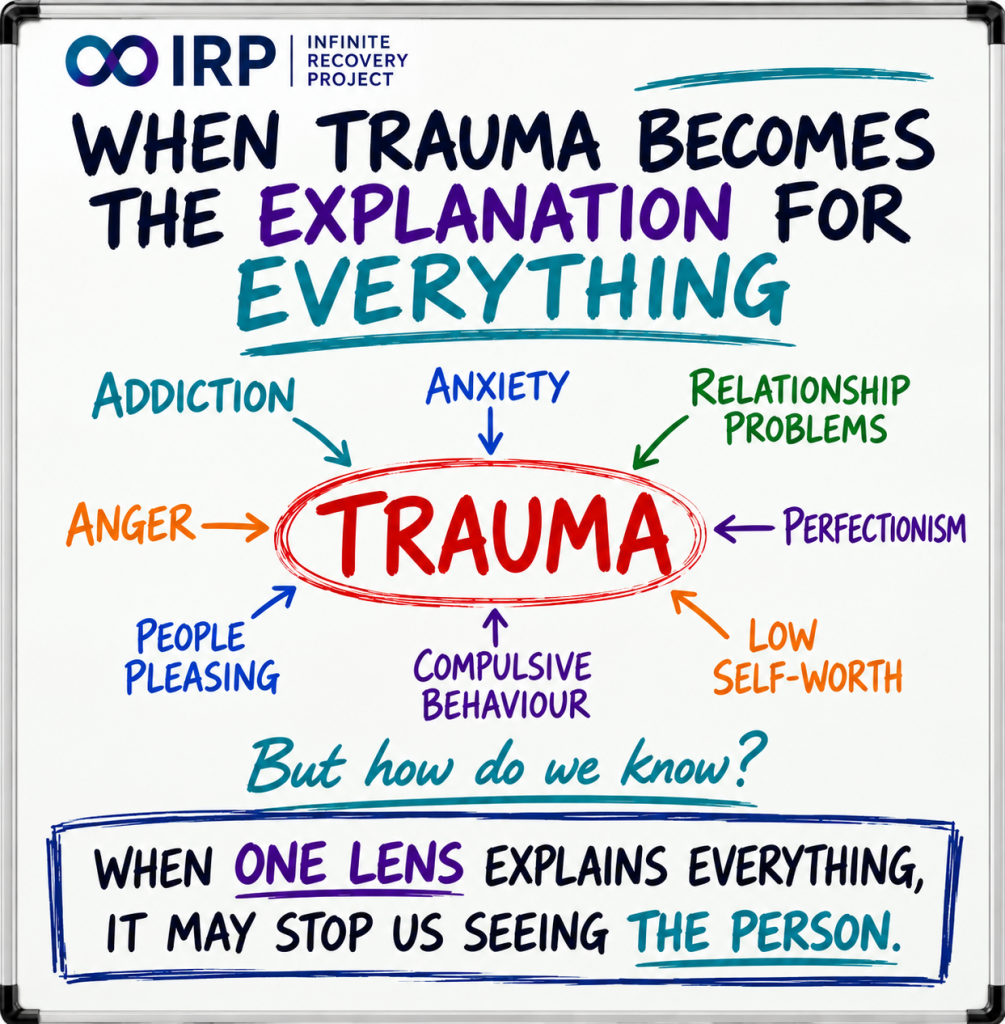
We have made trauma far too powerful!!

You say trauma caused the addiction. How do you know?? Not: why do you believe it Not: what theory supports it Not: what happened in childhood How do you actually know that this is what caused this person’s addiction?? —– Two people can grow up in the same home Experience similar events Carry very different meanings Adapt in completely different ways – One may use drugs – One may become controlling – One may disappear into work – One may appear completely unaffected So the event alone cannot tell us the outcome Trauma may matter enormously But once we decide this is the cause, something subtle happens We start looking for evidence that confirms it! We ask trauma-shaped questions We interpret the person through the answer we already have And eventually the explanation can become more visible than the person I’m less interested now in asking What caused your addiction? And more interested in How did your experience become organised in such a way that this behaviour made sense? That question doesn’t deny trauma It simply refuses to decide the answer before we understand the person Next week, I’m bringing a small group together for a live inquiry into exactly these kinds of assumptions Not to replace one addiction model with another To see what becomes visible when we stop protecting the answers we already have – https://lnkd.in/eSGuC6Ry

Guidance, Professionals, Recovery

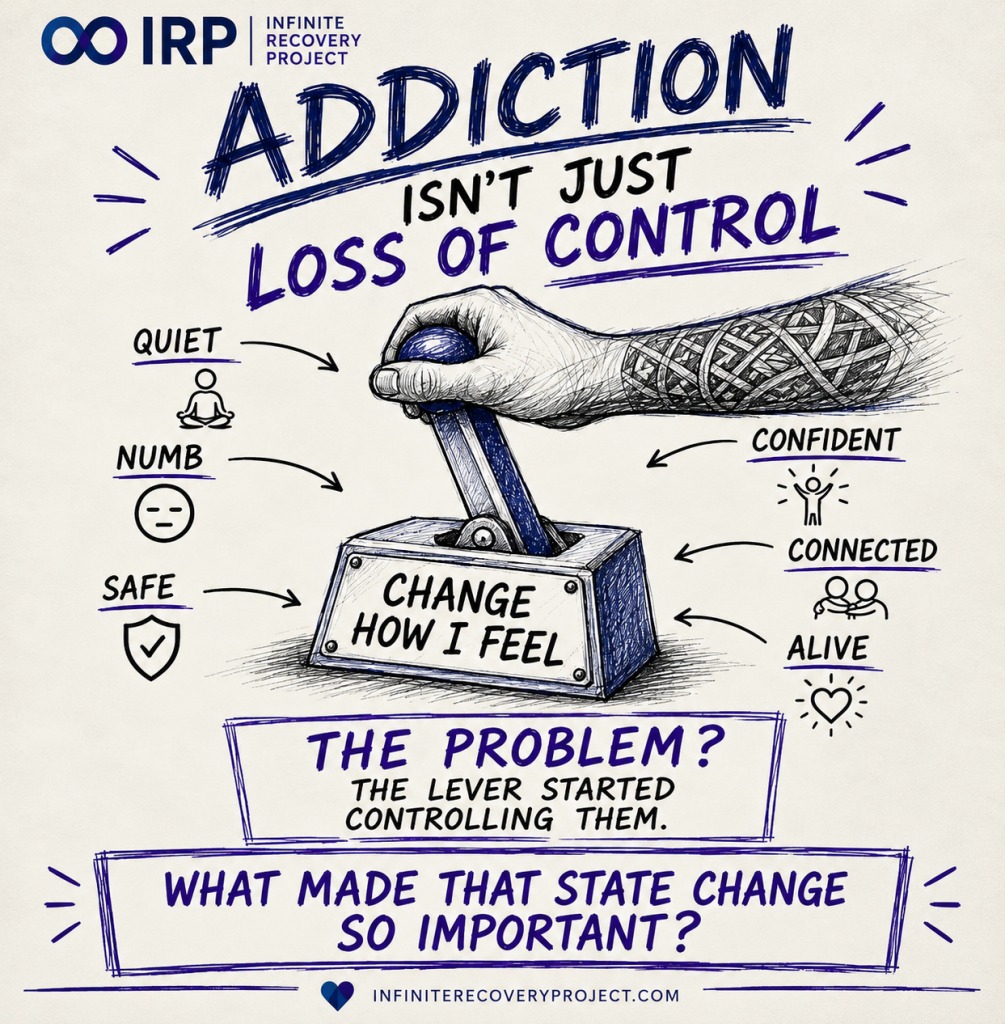
Addiction Isn’t Just a Loss of Control

It’s an attempt to control, the uncontrollable! We usually describe addiction by what happens eventually – Loss of control – Compulsion – Consequences – Unable to stop But that misses what happened first At some point, the drug or behaviour gave the person more control over their experience, not less Alcohol could quiet the mind Heroin could make everything disappear Cocaine could create confidence Gambling could replace emptiness with intensity Porn could create connection without vulnerability Food could soothe The behaviour changed something that, at the time, the person didn’t know how else to change And that is the paradox of addiction What eventually takes control often begins as a way of gaining it  So the important question isn’t only Where did they lose control? it is What were they trying so desperately to control in the first place? Their thoughts? Their feelings? How close people could get? How alone they felt? How much they could feel? How little they could feel? And perhaps even “control” is too narrow for some people The real inquiry is What changed when they used – and why did that change become so important? That question takes us somewhere very different from simply trying to stop the behaviour Because addiction may look irrational from the outside But from inside the experience that created it, it may have been one of the most effective solutions the person had ever found And that is exactly why taking it away is not the same thing as understanding it

Guidance, Professionals, Recovery

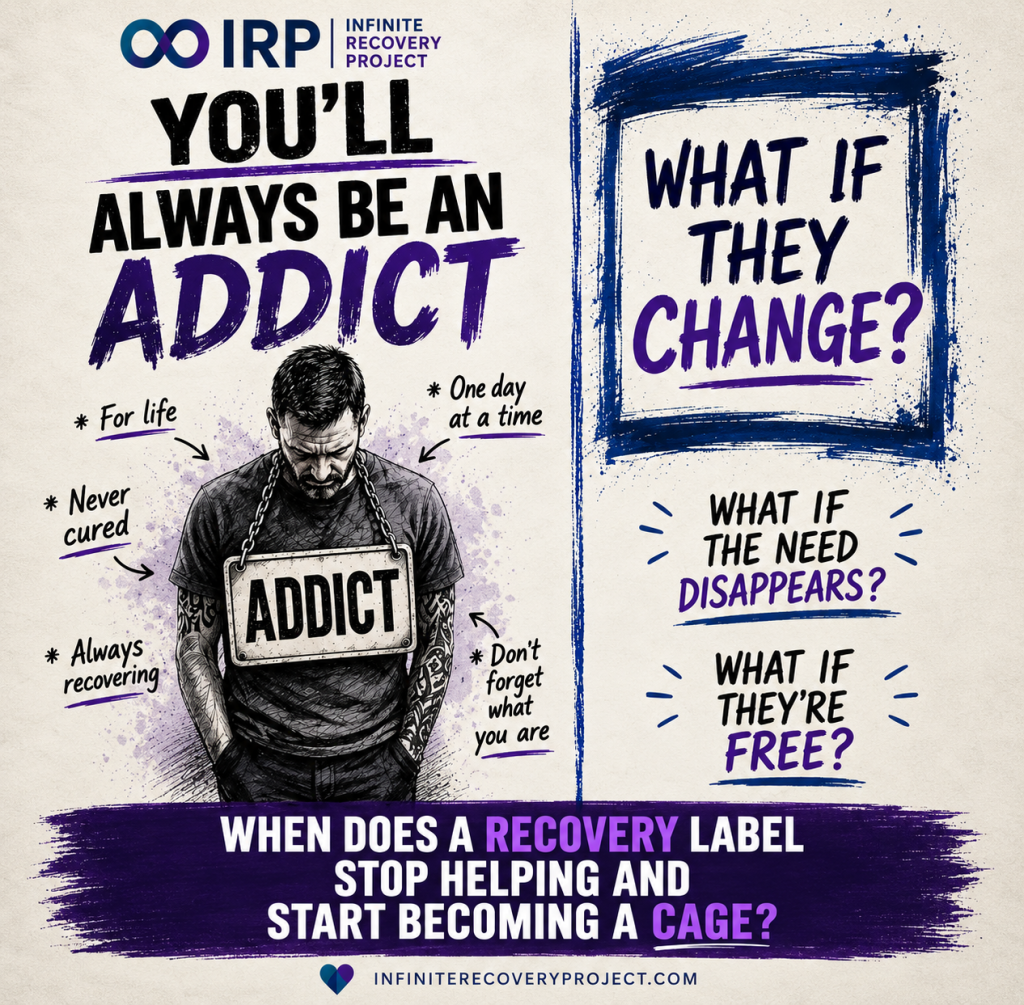
The Most Dangerous Thing We Tell People with Addiction is…. “You’ll Always be an Addict”

Think about what that sentence does It takes a pattern of behaviour, suffering and adaptation… and turns it into an identity!! Not – You became dependent Not – Something happened that made this behaviour necessary But – This is what and who you are For life..full stop And once that identity is accepted, everything starts organising around it – Every craving becomes proof – Every bad day becomes proof – Every mistake becomes proof – Every thought becomes evidence that the addict is still there But what if the person changes? What if the need changes? What if the relationship to the substance changes completely? What if they no longer feel compelled? What if they are actually free? Do we still insist – No. You’re still an addict. You just have to manage it! I understand why that language helps some people It can create humility, community and vigilance But we should still be willing to ask what it costs Because there is a huge difference between saying, I had an addiction and – I am an addict One describes something that happened, the other can become a permanent identity And I’m not convinced healing should require someone to organise the rest of their life around the thing they were trying to become free from For me, the deeper question… When does a recovery identity stop helping someone heal and start limiting what they believe is possible? —– If you are interested to join an inquiry, live to understand how beliefs get in the way of healing, please join us – https://lnkd.in/eSGuC6Ry

Guidance, Professionals, Recovery

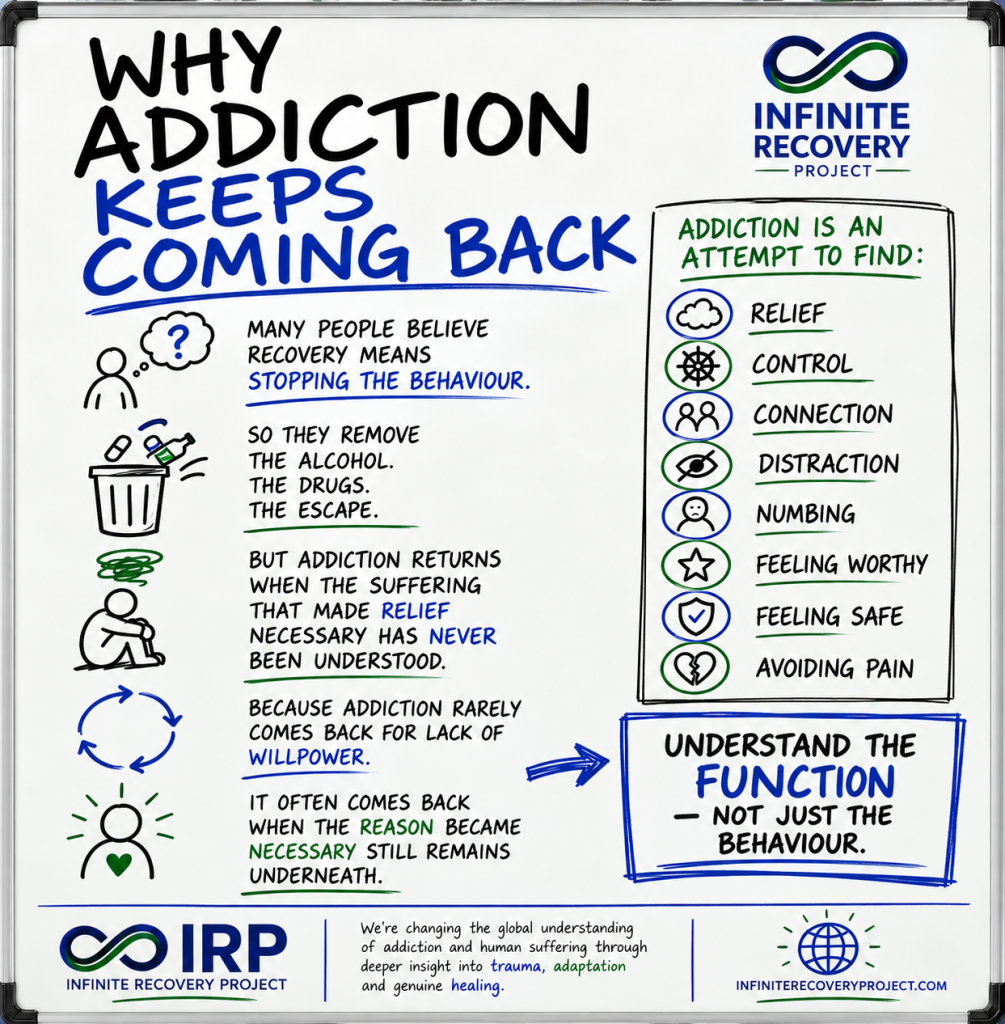
Why does addiction keep coming back?

Maybe we’ve been asking the wrong question Most conversations about addiction begin with the behaviour How do we stop drinking? How do we stop using? How do we stop relapsing? They’re important questions I’m interested in the question that comes before them What was the behaviour doing for this person? Not as an excuse Not as a justification As an attempt to understand Because people don’t become attached to alcohol, drugs, gambling or any other behaviour by accident They become attached to what those behaviours do For one person it’s relief For another it’s control For someone else it’s belonging, numbness, safety, distraction or a temporary escape from an internal experience that feels impossible to stay with If we only remove the behaviour, we may remove the person’s best available solution without understanding the problem it was solving That’s why so many people find themselves replacing one addiction with another, or remaining in recovery while still feeling trapped I’m becoming less interested in asking Why can’t they stop? and far more interested in asking What made stopping feel impossible? That single question changes where we begin And where we begin often determines where we end What do you think? Should addiction be understood primarily by the substance, or by the function it comes to serve?

Guidance, Professionals, Recovery

One day, everything changed

At that point in my life, I had spent years believing in pathology (Adopting a Model of Health in Addiction Treatment Personal Journey 6 Part Series Final Piece) I was a therapist An addict in recovery A person with diagnoses that started when I was around 10 years old, and there had been a lot of them! including multiple sectionings, and psychosis episodes I genuinely believed I would never be free! I thought I had a lifelong illness and the best I could hope for was management. By then I already had work, relationships, children, years clean from substances, and what many people would call a successful life. Yet underneath it all was the quiet belief that something was fundamentally wrong with me Then one day something shifted Not as a belief Not as motivation Not as another coping strategy It was like waking up from a nightmare I didn’t realise I was inside Nothing external had changed. I had not become richer, healthier, more successful, or more spiritual Yet internally everything became quiet For the first time in my life, there was peace underneath the noise I remember sitting outside hearing birds singing and realising I had spent most of my life psychologically trapped inside fear, diagnosis, identity, and survival Over the following months, the identity started dissolving Not intellectually Experientially I could no longer honestly say ‘I am broken’ ‘I am an addict’ ‘I am mentally ill underneath’ And something even more confronting started happening I realised I could no longer see clients through the same lens either Because if I was not fundamentally broken, maybe they weren’t either That did not mean trauma was not real Or nervous system dysregulation Or suffering It meant the entire foundation through which I understood suffering had changed  Research in trauma, attachment, and neuroscience increasingly supports the understanding that human beings adapt to overwhelming experiences biologically, psychologically, relationally, and behaviourally What changed for me was no longer seeing adaptation as evidence of defect Over the years that followed, I explored somatic work, relational healing, spirituality, nervous system regulation, contemplative practice, and deep self-inquiry Not to fix myself, but to understand what I already was underneath the adaptation This is why I keep saying throughout this series that adopting a model of health is not just intellectual People feel what we actually believe <THIS If we secretly still see ourselves or others as damaged underneath, the nervous system often senses that long before words do For me, this is where the model of health truly begins Not in theory Inside yourself

Scroll to Top