Work with Us

Infinite Recovery Project 2025

Guidance

Guidance, Professionals, Recovery

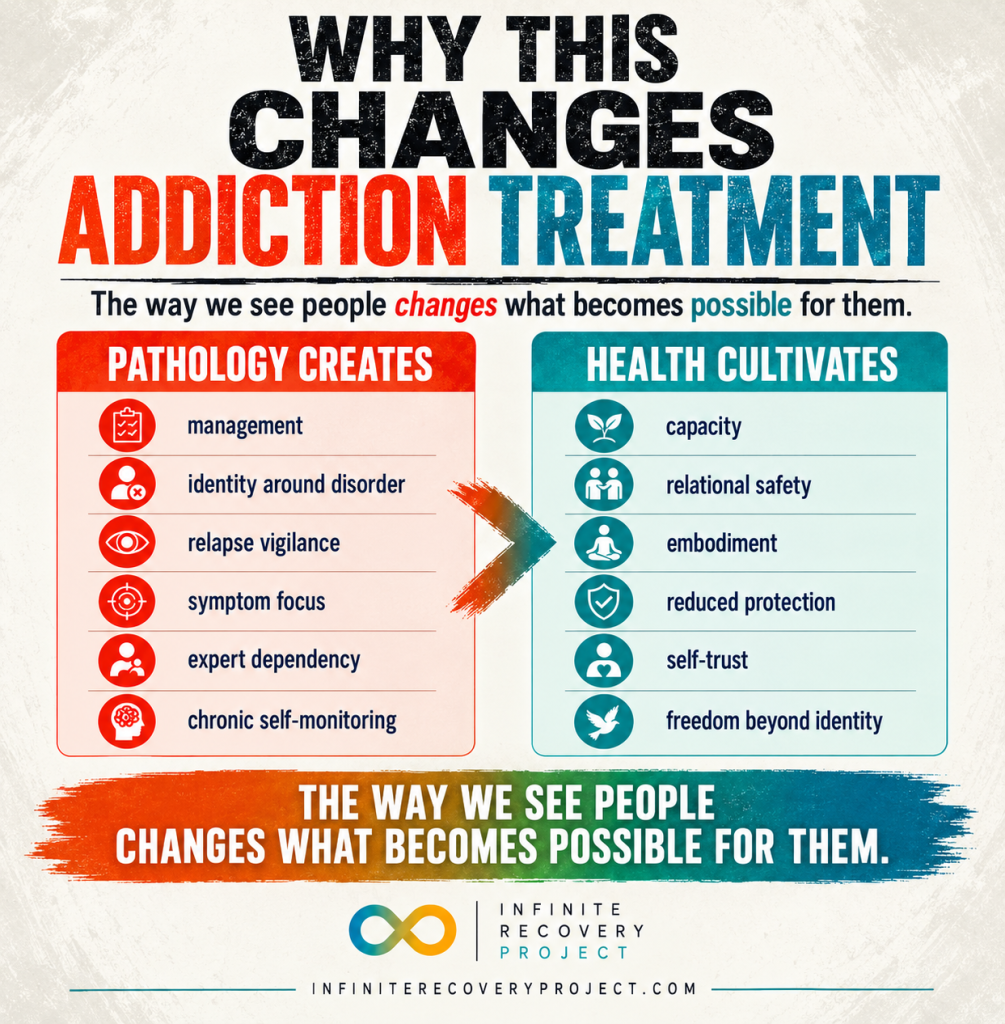
Why This Changes Addiction Treatment – Part 5 (Adopting a Model of Health for Addiction Treatment)

Over the last few posts I’ve been exploring a question that sits underneath almost every conversation in addiction treatment: What happens when we stop seeing human suffering primarily through pathology? Because the model we use does not just shape treatment techniques. It shapes the entire therapeutic relationship. It shapes what clinicians look for, what clients come to believe about themselves, and what recovery is imagined to mean If someone is fundamentally viewed as chronically disordered underneath their behaviour, treatment naturally moves toward management. Even when compassion, trauma awareness, neuroscience, and relational approaches are integrated, the underlying orientation can still quietly become one of stabilising dysfunction and preventing collapse A model of health changes the direction completely It does not deny biology, trauma, severe suffering, nervous system dysregulation, or the devastation addiction can create…. What it questions is the meaning we attach to those experiences. From this perspective, many behaviours begin to make sense as adaptations to overwhelm, shame, attachment pain, emotional suppression, fear, chronic stress, relational injury, and the absence of safety The person is no longer approached primarily as pathology, but as a human being whose system adapted intelligently under pressure That changes the role of treatment itself  The clinician is no longer simply positioned as the expert managing a defective system Therapy becomes more relational, experiential, and human. The work shifts toward helping a person develop greater safety, honesty, relational openness, emotional capacity, embodiment, and presence under pressure Research across attachment theory, interpersonal neurobiology, trauma, and relational psychotherapy increasingly points toward the importance of co-regulation, emotional integration, safety, and human connection in long-term healing outcomes (Schore, 2003; Siegel, 2012; van der Kolk, 2014) For me, this also touches something deeper spiritually. Not religion, ideology, or bypassing, but the recognition that beneath conditioning, protection, adaptation, and identity, there may not actually be a fundamentally broken self needing lifelong management There is already health there (but you have to see it in yourself first) And once that possibility is genuinely recognised, it becomes impossible to return to seeing people primarily through the lens of pathology The way we see human beings changes what becomes possible for them That may be one of the most important questions in all of addiction treatment This understanding will eventually change the global narrative on addiction
Guidance, Professionals, Recovery

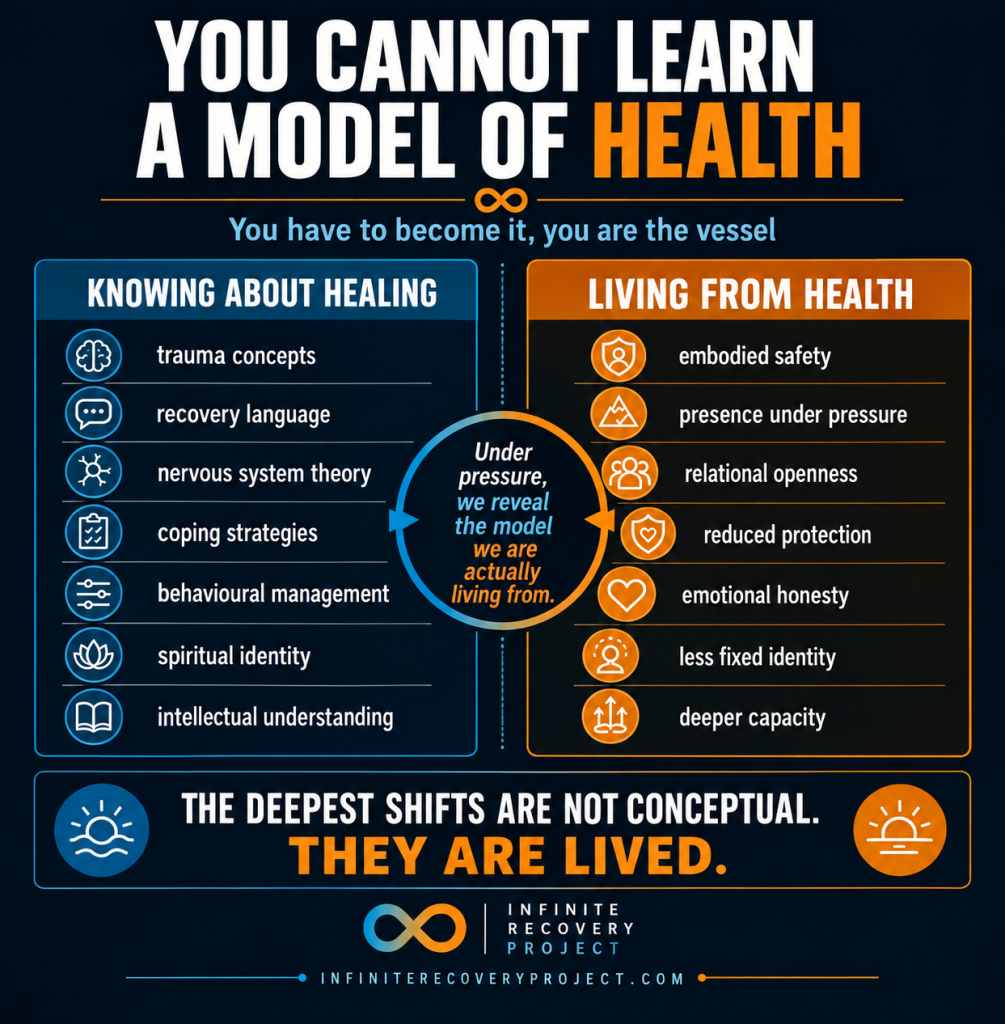
You Cannot Learn a Model of Health – Part 4 (Adopting a Model of Health in Addiction Treatment)

One of the biggest misunderstandings in recovery, therapy, and mental health work is the belief that health is primarily something we intellectually learn This isn’t true A person can study trauma, attachment, neuroscience, nervous system regulation, psychology, spirituality, addiction, recovery theory, and human behaviour for decades… …and still fundamentally organise around fear, protection, control, shame, identity, hypervigilance, performance, or emotional avoidance underneath This is why information alone doesn’t transforms people The mind can understand something long before the nervous system, relationships, and lived experience actually embody it Research across attachment theory, interpersonal neurobiology, and trauma increasingly points toward the importance of relational experience, embodied safety, co-regulation, and emotional integration rather than insight alone (Siegel, 2012; Schore, 2003) Human beings do not heal purely through concepts We heal relationally Experientially Embodied Under pressure In contact with life itself This becomes especially visible in relationships Someone may speak beautifully about healing, awareness, regulation, recovery, or spirituality… then become defensive, reactive, emotionally collapsed, controlling, avoidant, or dysregulated under intimacy, criticism, uncertainty, conflict, shame, rejection, or vulnerability That is not failure, it reveals that healing is deeper than intellectual understanding Under pressure, we reveal the model we are actually living from This is also where spirituality and awakening begin to matter in a very practical sense Not as belief systems Not as spiritual performance Not as bypassing pain But through the gradual recognition that much of what we experience as “self” is organised through conditioning, memory, adaptation, protection, and survival learning At deeper levels of healing, identity itself often starts becoming less fixed There is more openness More honesty More flexibility More relational capacity Less compulsive self-protection Less need to perform Less need to become someone The psychologist Carl Rogers spoke about trusting the ‘forward-moving tendency of the human organism’ toward growth and integration That tendency already exists within people Health is not something an expert installs into a broken person It is something gradually uncovered when the conditions maintaining protection begin to soften That is why a true model of health cannot simply be memorised, copied, or professionally performed It has to become lived And once someone genuinely begins experiencing human beings through that lens, it becomes impossible to return to seeing people primarily as pathology, disorder, or chronic defect underneath Not because suffering disappears Because the meaning of suffering changes completely

Guidance, Professionals, Recovery

Recovery Can Become Another Adaptation – Post 3 (Adopting a Model of Health in Addiction Treatment)

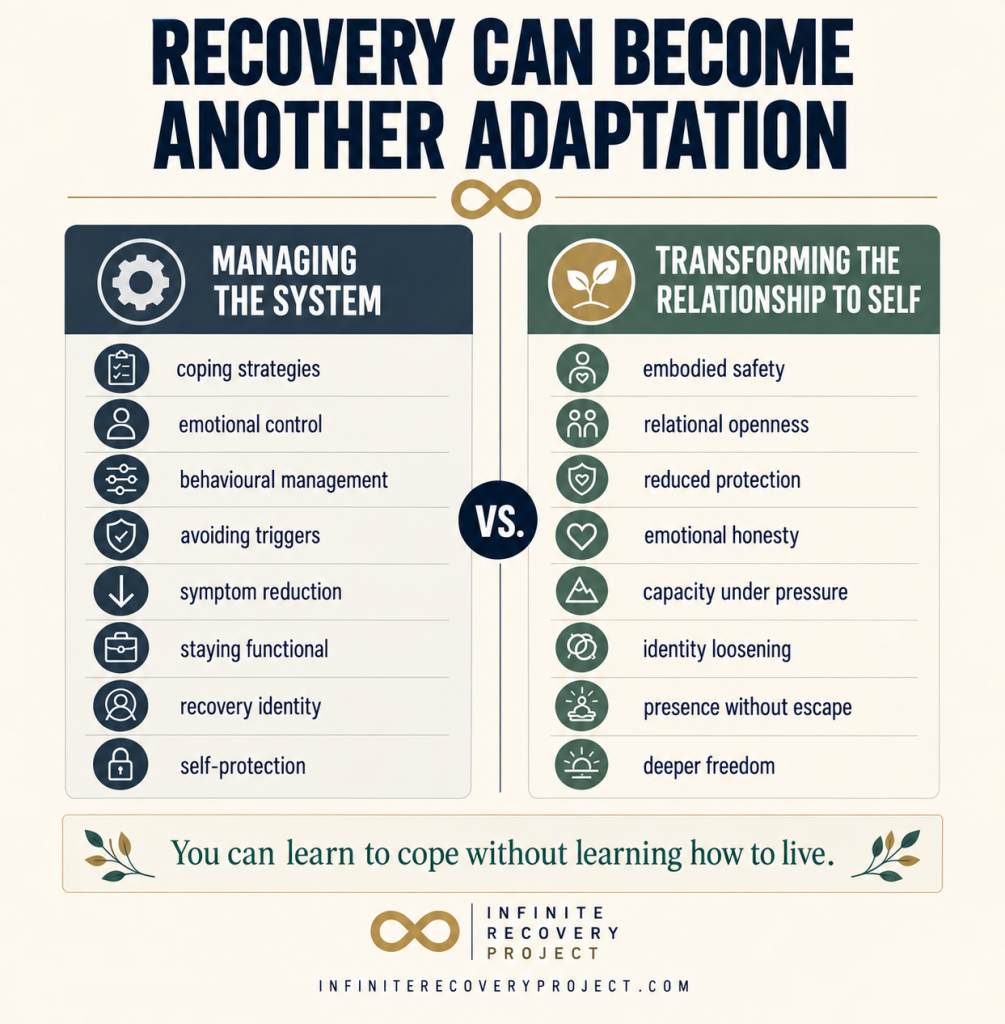
One of the more difficult conversations in recovery is recognising that sometimes the adaptation does not disappear It changes form A person may stop drinking, stop using, stop acting out, stop collapsing… while still organising their life around fear, control, protection, shame, hypervigilance, performance, emotional suppression, or identity From the outside, it can look like healing Inside, the system may still be trying to survive This is why stopping a behaviour is not always the same thing as freedom  And why coping is not the same thing as healing Many people become highly skilled at • managing themselves • controlling impulses • avoiding triggers • performing recovery • monitoring behaviour • suppressing emotion • staying functional • becoming the good recovered person But underneath, the nervous system may still not feel deeply safe This becomes especially visible in relationship Someone may appear calm and regulated alone, then become reactive under intimacy, criticism, uncertainty, vulnerability, conflict, rejection, or loss Why? Because real healing is not only behavioural It is relational It changes the relationship a person has with themselves, with emotion, with uncertainty, with others, and with life itself Research across attachment theory, trauma, and nervous system science increasingly shows that long-term emotional patterns are shaped relationally and expressed relationally. Human beings do not regulate in isolation That is why genuine regulation is not simply a technique It emerges through increased safety, honesty, embodiment, connection, relational capacity, and reduced need for protection This is also where spirituality and awakening begin to matter in a very practical way Not as bypassing Not as positive thinking Not as becoming spiritually identified But through recognising that much of what we call identity is itself organised around adaptation and protection The psychologist Carl Rogers wrote: ‘The curious paradox is that when I accept myself just as I am, then I can change.’ Real healing often begins there Not in becoming a better identity But in no longer needing to organise life around defence in the same way Recovery can absolutely save lives But if recovery itself becomes another structure built around fear, self-monitoring, performance, or identity protection, the deeper freedom many people are longing for may still remain out of reach —– If you or your organisation would like to learn more about Infinite Recovery a model of health for addiction treatment, send me a DM.

Guidance, Professionals, Recovery

Addiction Makes Sense – (Part 2 Adopting a health model in addiction treatment)

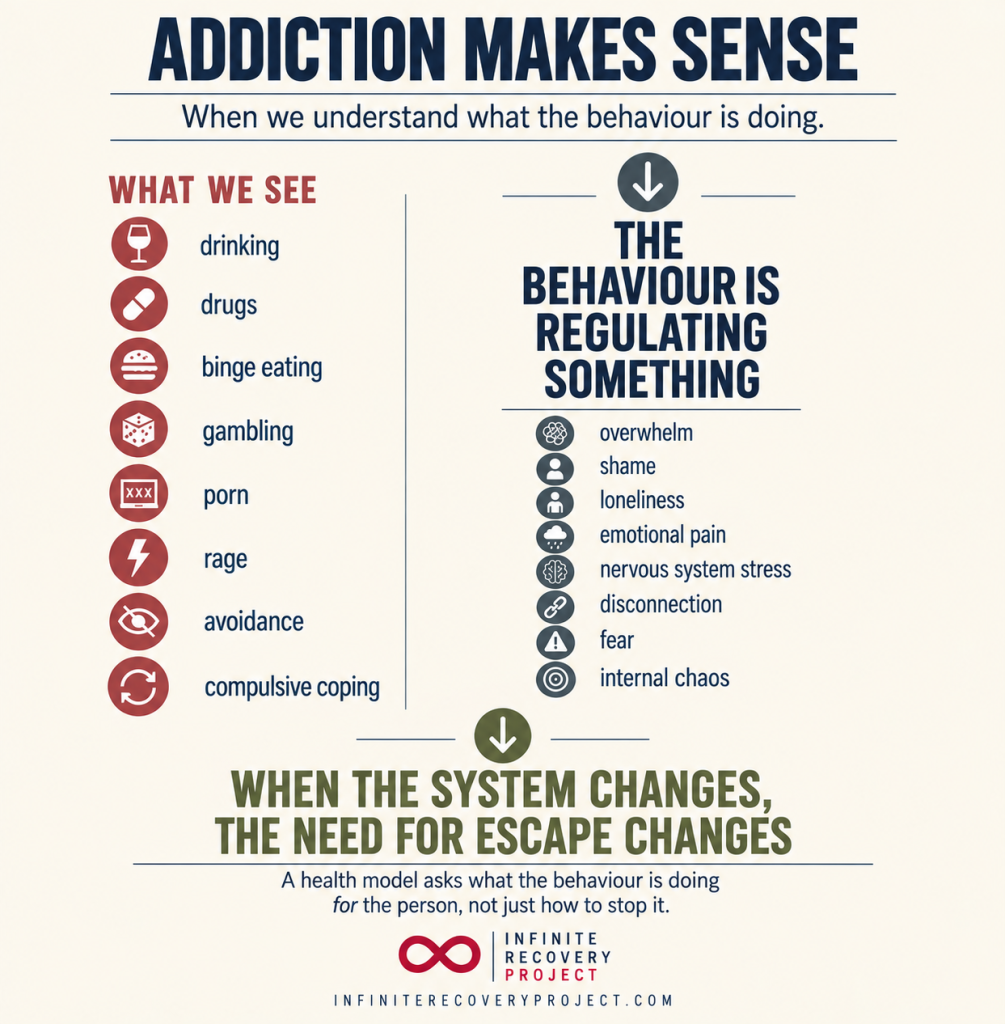
One of the biggest shifts in addiction treatment happens when we stop asking What is wrong with this person? and begin asking What is this behaviour doing for them? Because addiction makes sense Not morally Not socially Not in terms of consequences But psychologically, emotionally, biologically, and relationally Most addictive behaviours regulate something Overwhelm Shame Loneliness Hyperarousal Emotional pain Disconnection Nervous system collapse The absence of safety The absence of meaning That does not make addiction healthy, It makes it understandable Research over the last few decades has consistently shown strong relationships between trauma, attachment disruption, chronic stress, adverse childhood experiences, emotional dysregulation, and later substance use disorders The ACE Study found a graded relationship between childhood adversity and later addiction risk (Felitti et al., American Journal of Preventive Medicine, 1998) Attachment research has repeatedly demonstrated that early relational environments shape emotional regulation, stress response, identity formation, and coping strategies later in life (Bowlby, 1969; Schore, 2003) Trauma research further expanded understanding of how human beings adapt physiologically to chronic states of threat, disconnection, and survival stress (Porges, 2011; van der Kolk, 2014) From this perspective, addiction stops looking random It begins to look biological adaptive intelligence, evidence that the system is working exactly as it’s designed to do An attempt to regulate unbearable internal states when healthier regulation, relational safety, emotional processing, or nervous system capacity were not sufficiently available This understanding changes treatment Because if the behaviour is adaptive, then simply removing the behaviour does not automatically resolve the underlying conditions that made it necessary When people are struggling or even relapsing, we can ask What is the person still trying to survive internally? That does not remove personal responsibility, It deepens understanding And understanding changes outcomes A model and understanding of health does not ask people to identify as permanently broken underneath their coping patterns It asks What happened? What adapted? What remains unresolved? What capacities were never fully developed? What does this person need in order to no longer require escape? Fundamentally different to pathology Addiction makes far more sense when we stop viewing people as pathology first and begin viewing them as human beings adapting to life the best way they could ——— Are you or your organisation seeing the health in people more and more, and want to adopt a model of health? send me a DM

Guidance, Professionals, Recovery

Part 1 – The Model Changes the Outcome (Adopting a Model of Health for Addiction Treatment)

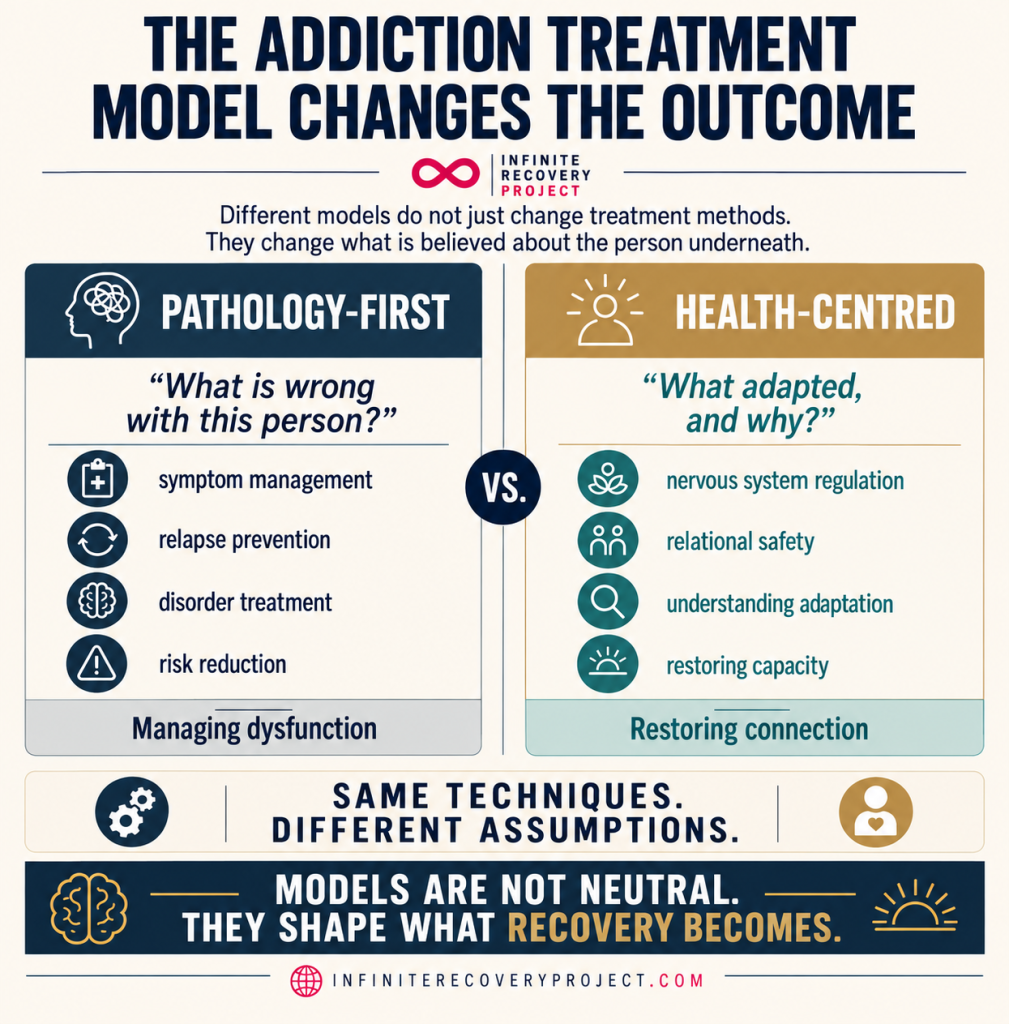
One of the biggest misunderstandings in addiction treatment is the belief that models are neutral They are not The lens we look through shapes • what we see • what we ignore • what we measure • what we believe is possible • and what people eventually come to believe about themselves This matters far more than most people realise If a clinician fundamentally sees addiction as evidence of chronic pathology, disease or dysfunction, treatment naturally becomes organised around management, symptom reduction, relapse prevention and lifelong maintenance Even when compassion is added Even when trauma is included The underlying assumption still quietly remains something is wrong with the person underneath That assumption changes everything Research across psychology and neuroscience has repeatedly shown that beliefs, expectations, identity, relational context, and prediction shape human experience and behaviour. The placebo/nocebo literature alone demonstrates that the meanings people attach to themselves and their conditions can influence outcomes biologically, psychologically, and behaviourally At the same time, attachment research, trauma research, and nervous system science increasingly point toward adaptation, survival learning, relational conditioning, and embodied prediction rather than simple defect models. So, what if many behaviours we call pathology make more sense as intelligent adaptations to overwhelm, disconnection, stress, attachment wounds, relational pain, shame, fear, and nervous system survival responses? That does not minimise suffering, but It changes how suffering is understood A pathology-first model tends to ask “What disorder is this?” A health centred model asks What happened? What adapted? What is this behaviour doing for the person? What conditions allow reconnection, regulation, safety, honesty, and relational capacity to emerge? Those are not small differences They produce entirely different treatment environments, identities, expectations, and possibilities This is also why a genuine model of health cannot simply be intellectually learned Someone can study trauma, attachment, neuroscience, nervous system regulation, and recovery for decades, yet still perceive human beings as broken underneath A true model of health is not just conceptual It is relational Embodied Experiential Spiritual It involves seeing directly that beneath conditioning, protection, adaptation, and identity, there is not a defective human being needing to become whole There is already health there  And once that is genuinely seen clearly, it becomes impossible to return to a lens that primarily interprets human suffering as pathology Because the meaning of suffering changes completely  —- NEXT PART 2: “Why Addiction Makes Sense”

Guidance, Professionals, Recovery

Adopting a Model of Health in Addiction Treatment – Multi Part

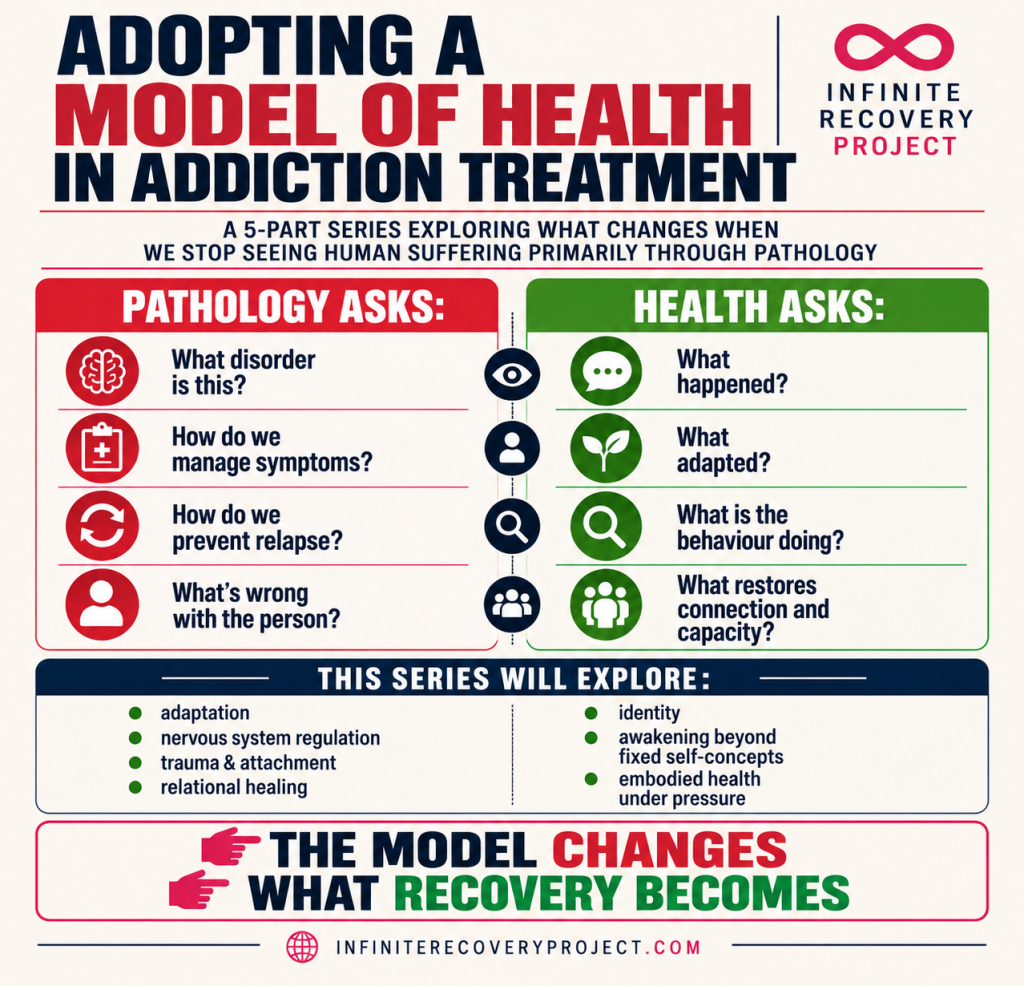
Over the next few days, I’m going to be sharing a multi part series on something I believe sits underneath much of the confusion, conflict, and limitation within addiction treatment What happens when we adopt a model of  health instead of a model of pathology? This is not an attack on people working in recovery, treatment, psychology, psychiatry, trauma therapy, neuroscience, or mutual aid Many people within those systems really care and genuinely help others This series is about something deeper the lens through which we understand human suffering itself Because models are not neutral They shape: • what clinicians look for • what clients believe about themselves • what gets treated • what gets ignored • what outcomes seem possible • what people begin to identify as In this series I’ll explore more about Why the model changes the outcome Why addiction makes sense as adaptation Why regulation is not the same as healing Why a model of health cannot simply be intellectually learned Why this changes the entire foundation of addiction treatment This conversation will include • nervous system regulation • trauma and attachment • relational healing • identity • adaptation • embodied safety • awakening beyond fixed self-concepts • and what happens under pressure in real human relationships One of the most important distinctions I’ll be making is this You can understand trauma intellectually and still fundamentally relate to yourself as broken underneath You can learn regulation skills and still live inside fear, shame, performance, control, and identity protection You can stop behaviours without discovering freedom For me, a true model of health is not simply a new theory about human beings It is something lived, embodied, relational, and directly realised (this also makes measurement very difficult, but it can be known) And once health is genuinely seen clearly, it becomes very difficult to keep interpreting human suffering primarily through the lens of defect, disorder, or permanent pathology That does not minimise pain It changes how we understand it  Part 1 coming next: – The Model Changes the Outcome —– Let me know below if you would like to be part of it, the more we share, comment and engage, the more this grows.

Guidance, Professionals, Recovery

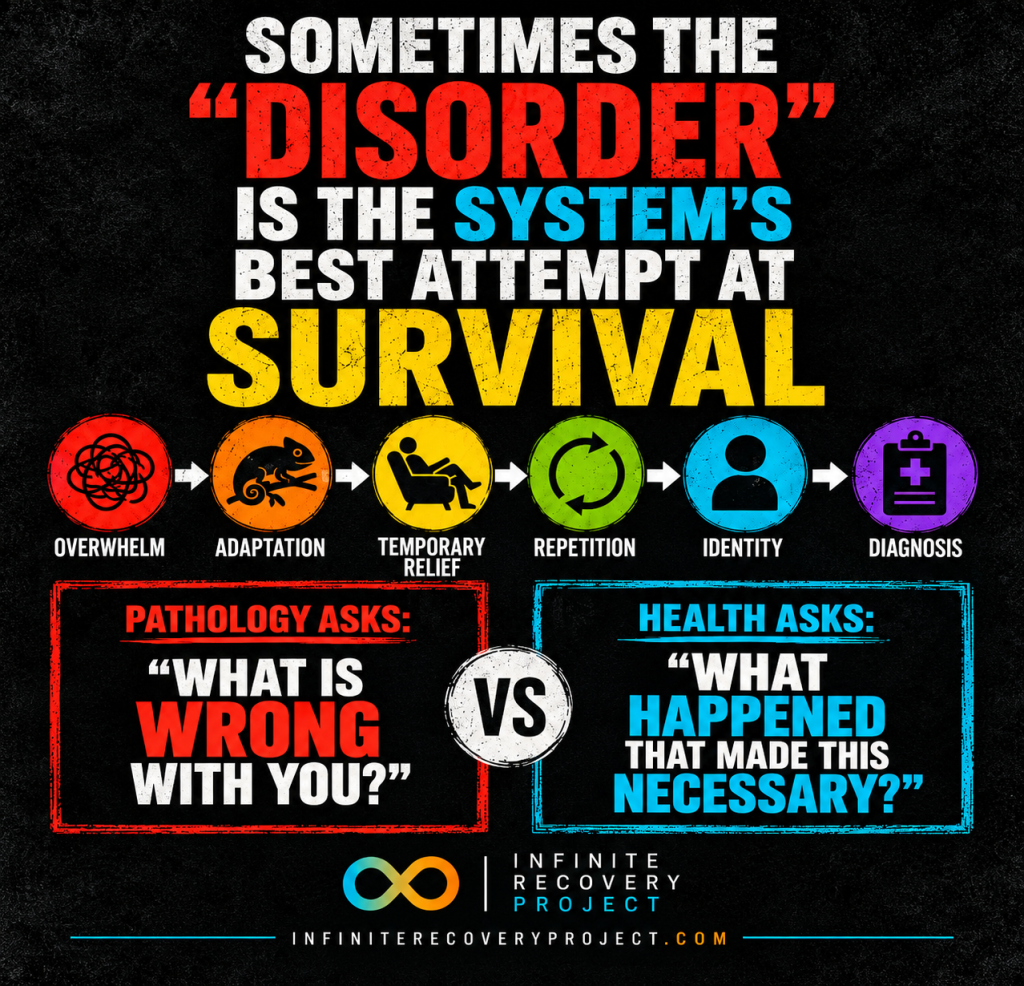
The “disorder” is the system’s best attempt at survival

That sentence can sound provocative until you really slow down and look at human behaviour honestly A child grows up in an environment that feels unsafe, overwhelming, emotionally unpredictable, rejecting, or disconnected. The nervous system adapts around those conditions because it has to Not because the child is broken Because the human system is intelligent Years later, those adaptations may no longer look helpful. The person may become emotionally shut down, hypervigilant, reactive, perfectionistic, self-destructive, or addicted to behaviours that temporarily relieve internal pressure Eventually something creates relief Alcohol quiets the noise Food comforts Work distracts Porn numbs Gambling creates escape Control creates temporary safety And the body remembers Not morally, but biologically The system learns This helps me survive what I’m carrying That is why addiction makes more sense when we stop seeing it as random pathology and start understanding it as intelligent biological adaptation Research across trauma, attachment, and neuroscience increasingly supports the understanding that chronic stress and relational environments shape the nervous system, emotional regulation, behaviour, and long-term coping patterns (Felitti et al., 1998; Schore, 2003) This does not remove responsibility or consequences, but, It changes where we begin! Because if we only ask What is wrong with this person? we can completely miss the intelligence inside the behaviour itself The same unresolved wound can later appear as anxiety, depression, addiction, rage, perfectionism, burnout, emotional collapse, or relationship chaos Different expressions of the same human system trying to survive in the only ways it learned how That changes the conversation from blame and symptom management toward deeper understanding… Not How do we control the behaviour? But What happened that made this adaptation necessary in the first place? ——– This simple understanding of adaptive intelligence begins to remove stigma because people no longer feel seen as defective underneath, but understood as human beings whose systems adapted intelligently to pain, overwhelm, disconnection, or survival. That changes the entire relational environment around healing. Shame softens, defence softens, people feel safer to tell the truth, safer to be seen, and safer to explore what is actually happening underneath the behaviour. From that place, recovery stops becoming a lifelong fight against yourself and starts becoming a process of reconnection, safety, honesty, increased capacity, and genuine healing at depth.

Guidance, Professionals, Recovery

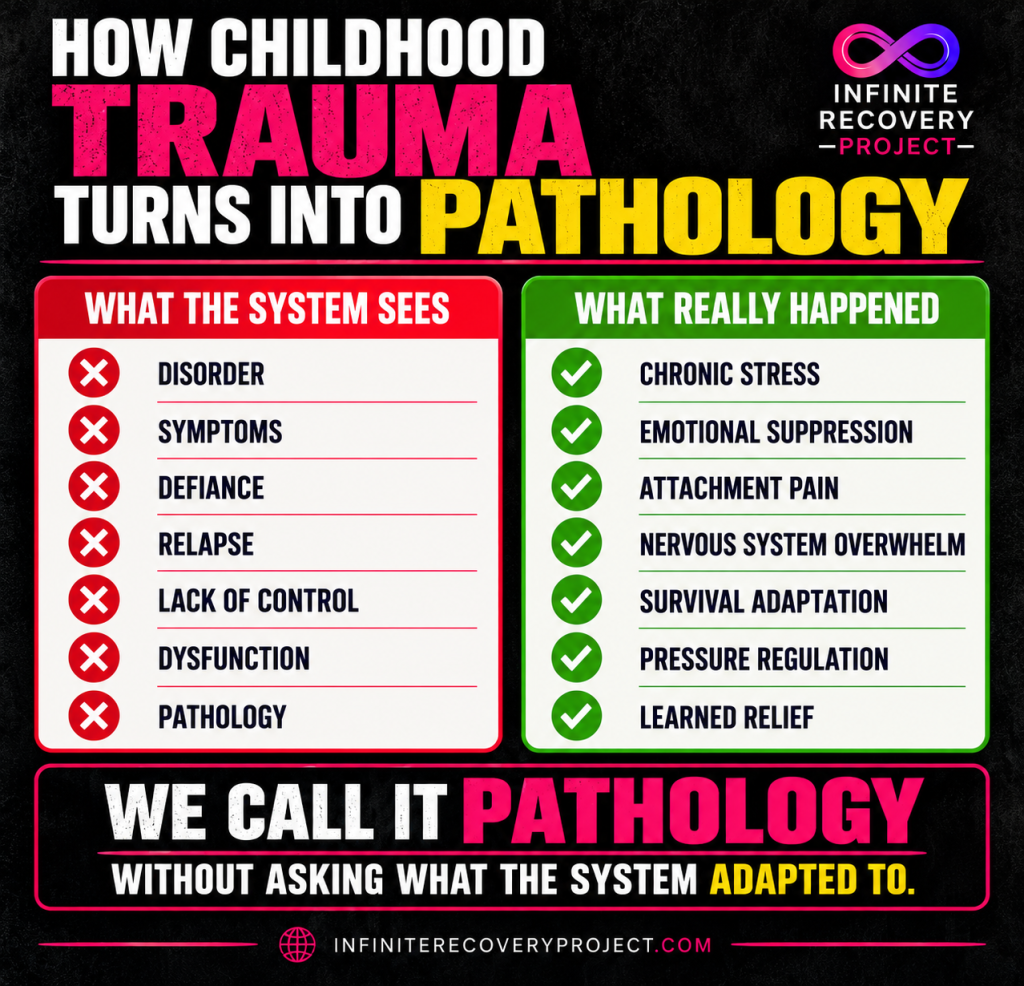
How Childhood Trauma Turns into Pathology

We are very quick to label the adaptation… while ignoring the conditions the adaptation emerged within A child grows up around chronic stress, unpredictability, emotional suppression, shame, fear, neglect, disconnection, or overwhelming environments The nervous system adapts Not because the child is broken Because the human system is intelligent, it learns to find respite, it is a self correcting natural biological response to the adversity it faces Years later, those same adaptations can become: • addiction • anxiety • compulsive behaviour • emotional shutdown • hypervigilance • relationship difficulties • self-destructive coping patterns Then the system often gets labelled – ‘disordered’ ‘dysfunctional’ ‘attention seeking’ ‘addict’ ‘mentally ill’ Without ever seriously asking – What did this person have to adapt to? Research has consistently shown strong links between early adversity and later addiction, mental health struggles, and chronic stress patterns. The ACE Study (Adverse Childhood Experiences) found a significant relationship between childhood adversity and increased risk of substance misuse, depression, suicidality, and physical disease later in life. At the same time, newer understandings from trauma research, attachment theory, and neuroscience increasingly point toward adaptation, prediction, survival learning, and nervous system conditioning rather than simple moral failure or fixed pathology. Gabor Maté Bessel van der Kolk Stephen Porges Daniel Siegel This does not mean personal responsibility disappears It means understanding deepens When we understand behaviour through the lens of adaptation, the conversation changes From ‘What’s wrong with you?’ to ‘What happened to you?’ and even deeper  ‘What did your system learn it needed to do to survive?’ That makes a difference because people heal far more effectively when they are understood as human beings adapting to life… rather than problems to be managed. ——– If you are interested in learning more about addiction as an adaptive intelligence, we run workshops for organisations more details here – https://lnkd.in/ePhyP_b8 previous participants 100 % of people said they would recommend this

Guidance, Professionals, Recovery

Most addiction treatment is built on one assumption

Something is wrong with the person So treatment focuses on: controlling behaviour, managing symptoms, preventing relapse, and maintaining the condition But what if addicton is not the problem? What if it’s the system’s attempt to solve a problem? Because when you sit with people long enough, you start noticing something… The behaviour is rarely random It regulates pressure It creates relief It numbs overwhelm It gives connection It creates escape It restores control That does not make addiction healthy But it does make it understandable And the moment behaviour becomes understandable, treatment changes You stop asking: ‘How do we stop this person using?’ And start asking: ‘What happens inside them before the urge appears?’ That shift changes everything Because people do not heal through shame, labels, fear, or lifelong identification with being broken They heal when the underlying system no longer needs the behaviour in the same way That is not ideology That is what many clinicians, trauma therapists, and people in long-term recovery quietly discover after years in the field! —– if you’re interested in learning more about addiction as intelligence, I’m open to talks workshops in your organisation in how you might adopt this new approach.

Guidance, Professionals, Recovery

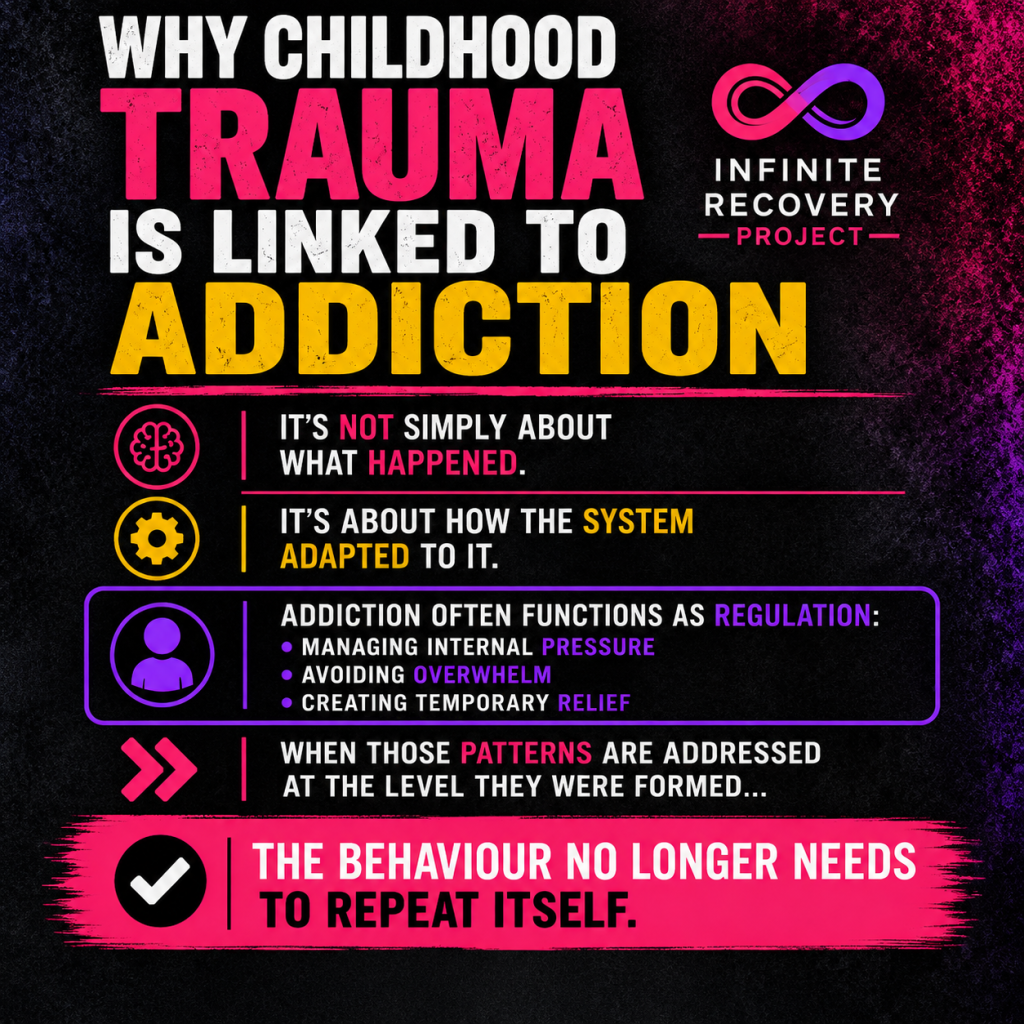
Why childhood trauma is linked to addiction

Most conversations stop at what happened, that’s only part of the picture What matters just as much is how the system adapts to it Decades of research support the link, the ACE study (Felitti et al., 1998) showed a strong dose response relationship between early adversity and later substance use Van der Kolk (2014) and others highlights how trauma is not just remembered cognitively, but organised in the body and nervous system From that lens, addiction is not random, and it isn’t simply a lack of willpower, or a disease that is unexplainable It is a functional response A way of • managing internal pressure • avoiding overwhelm • creating temporary relief Neuroscience also reflects this. Chronic stress alters threat detection, reward processing, and emotional regulation (e.g. dysregulation across limbic and prefrontal systems). The behaviour then makes sense in context The problem is how we respond to it Most treatment models focus on removing the behaviour, while leaving the underlying system unchanged. That’s why outcomes often don’t hold, the behaviour shifts, but the pressure remains At the Infinite Recovery Project, the work is different We are not treating addiction as a primary disorder or identity, we are understanding it as an adaptive response to internal and relational conditions So the focus shifts: From stopping behaviour → to understanding what it’s doing From pathology → to intelligent function From control → to increasing capacity When the underlying patterns are met at the level they were formed – in the nervous system, in relationship, in lived experience, the need for the behaviour reduces naturally Not because it’s forced out, but because it’s no longer required, addiction is resolved at this point And that’s where real change happens

Scroll to Top