Work with Us

Infinite Recovery Project 2025

Guidance

Guidance, Professionals, Recovery

NEEDING RECOVERY FOREVER ISN’T RECOVERY!

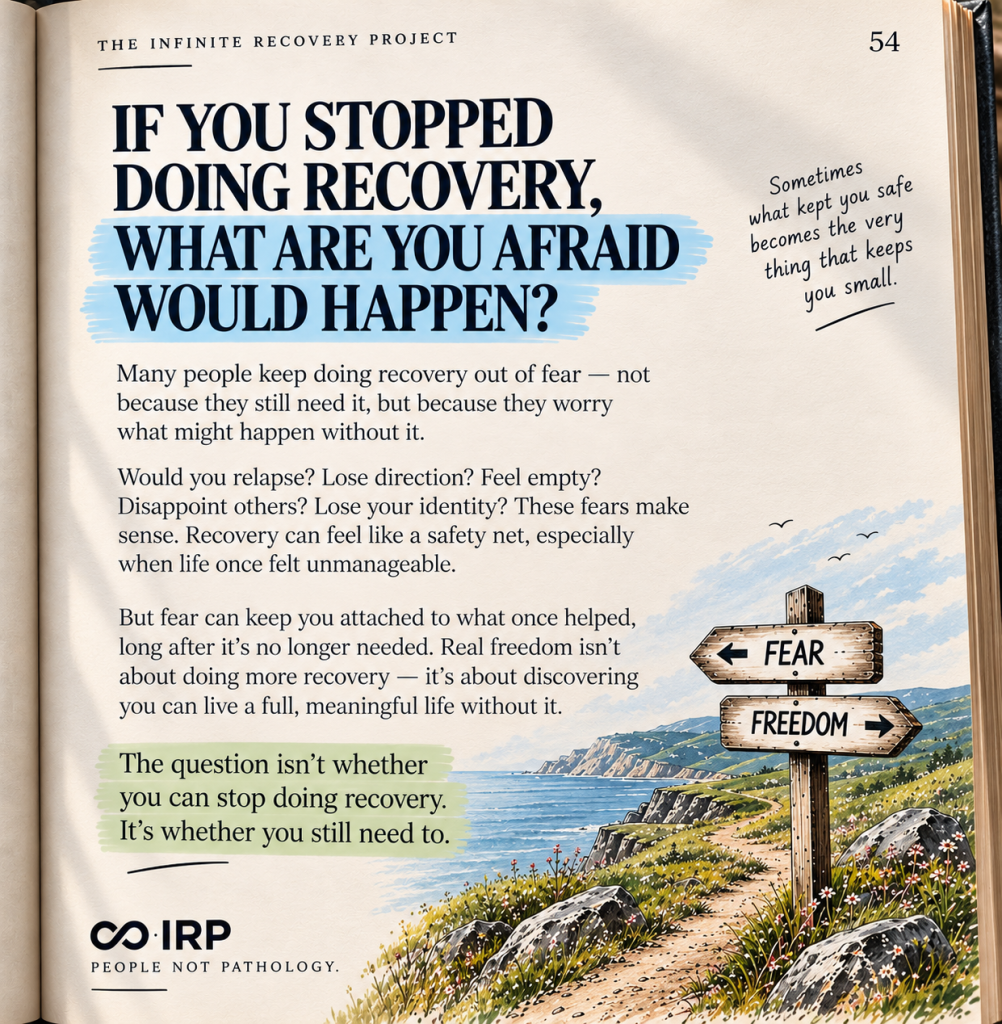
For much of the years I spent in fellowships, stopping recovery was unthinkable! Because I knew what could happen, or at least I thought I did Stop doing the things that keep you well and eventually the old you comes back Stop going to meetings Stop working on yourself Stop maintaining your recovery Become complacent Relapse Maybe die So continuing to “do recovery” becomes evidence that you’re taking your recovery seriously But eventually I had to ask myself a question I hadn’t really been willing to ask! What exactly am I afraid would happen if I stopped? And an even more uncomfortable one! If I have to organise my life around preventing addiction, what do I actually mean when I say I am free from it? To be clear – I’m not saying people should stop going to meetings I’m not saying they should abandon something that enriches their life And I’m certainly not saying everyone should follow the path I eventually took I’m questioning the assumption that needing recovery idefinitely must automatically be considered recovery Because there is a difference between I still do this because it adds something beautiful to my life and I have to keep doing this because I’m frightened of who I’ll become without it Those can look identical from the outside Thirty years of meetings Thirty years of fellowship Thirty years of practice But internally they could represent completely different relationships with recovery One chosen freely The other maintained through fear And perhaps we’ve become so accustomed to celebrating the continuation of recovery that we don’t ask the person the most obvious question What do you believe would happen if you stopped? Would you relapse? Lose yourself? Become selfish? Return to the person you used to be? Does something dangerous still live inside you that recovery is keeping under control? And if the answer is yes, I’m not interested in telling you you’re wrong I’m interested in the question that follows: Where did you learn that about yourself? Because perhaps the ultimate purpose of recovery isn’t to become exceptionally good at doing recovery Perhaps it’s to reach a point where your life is no longer organised around addiction I don’t think freedom should require us to forget what helped us But I do think we should be allowed to ask whether we still need it If you stopped “doing recovery” tomorrow, what are you afraid would happen?
Guidance, Professionals, Recovery

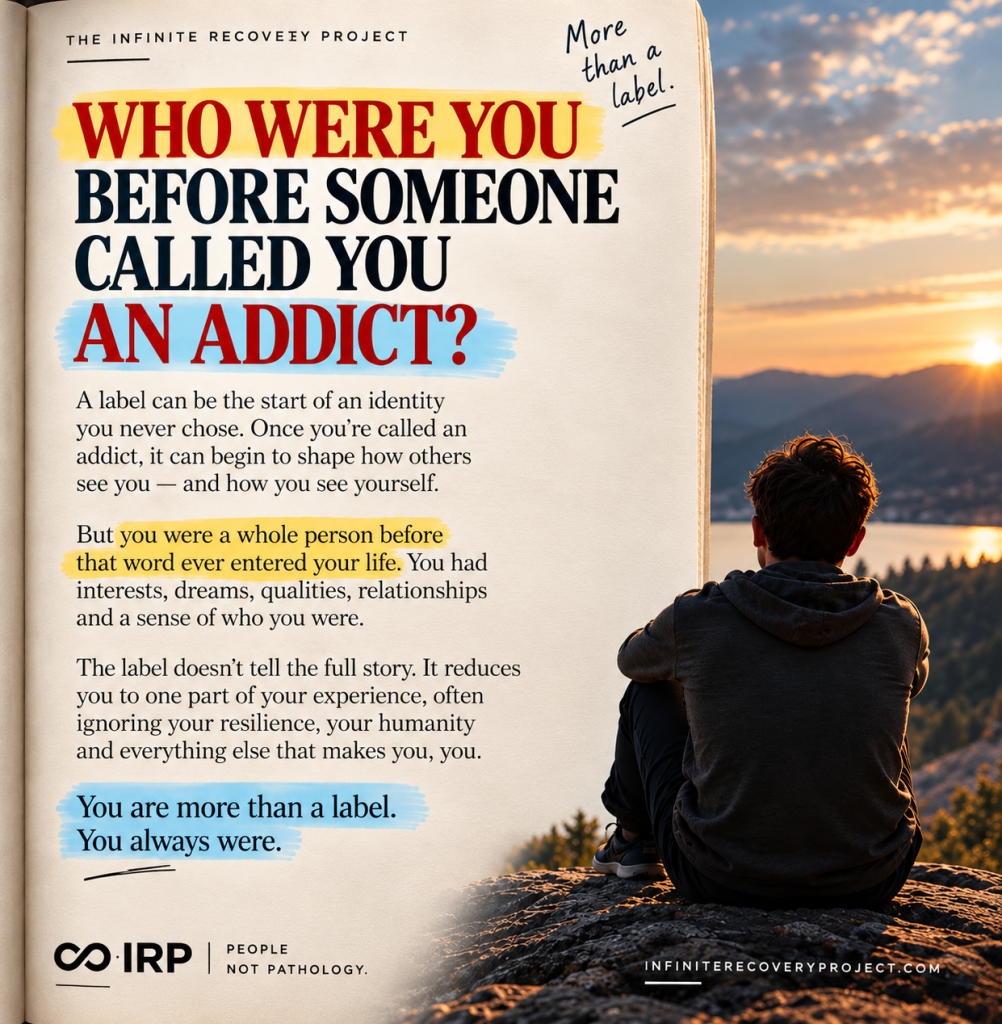
Who were you before someone called you an addict?

And perhaps the deeper question is Who were you before anyone called you anything? Before addict Before alcoholic Before broken Before recovered Before successful Before failure Before even your name became your answer to the question Who are you? You are a seamless flow of thoughts, feelings, sensations and perceptions – Rupert Spira or as Osho put it even more simply You are what you are seeking! This matters enormously in addiction Because a label can begin as a useful description and quietly become an identity I used drugs becomes I am an addict And once “this is what I am” becomes settled, the mind naturally begins looking at life from inside that conclusion A craving appears: There it is – I’m an addict You struggle with food, sex, relationships, money or work: My addiction is manifesting somewhere else You feel anxious or restless: That’s my disease You feel well for twenty years: That’s because I’m successfully managing my disease The identity can become remarkably difficult to disconfirm because almost every experience can be interpreted as evidence for it That’s where confirmation bias becomes more than an intellectual mistake It can become a way of experiencing yourself The story selects the evidence The evidence strengthens the story And eventually the story can feel like the person I’m not saying nobody should call themselves an addict or alcoholic. If those words are meaningful or helpful to you, that’s yours to decide I’m asking something much more fundamental Are you the identity – or are you the one who is aware of the identity? Osho said, “Truth is not something outside to be discovered, it is something inside to be realised” Perhaps recovery can take us to an unexpected place Not a better identity Not addict replaced by recovering addict Not a more acceptable story about ourselves But the discovery that no story we have ever told about ourselves has contained the whole of what we are You existed before the label You are here while the label is being thought And you will still be here if one day you put it down So when you say, “I am an addict” – what exactly do you mean by “I”?

Guidance, Professionals, Recovery

What If The Thing That Saved Your Life Is Now Keeping You Stuck?

That’s an uncomfortable question, isn’t it? Especially when you believe you owe your life to something A programme, A belief system, A recovery identity, A way of understanding yourself I spent 22 years in 12-Step recovery It helped me stop using drugs. I’m grateful for that, I still recommend it to people But for much of that time, I also believed I was an addict for life. That something was permanently wrong with me. That recovery was something I would always need to maintain… I didn’t question those beliefs Why would I? They were part of the very thing I believed had saved my life And that’s what interests me What happens when gratitude prevents us from questioning something? When does something that once gave us freedom begin defining its limits? When does an explanation that helped us survive become an identity we cannot imagine living without? I’m not suggesting anyone abandon what helps them! I’m really asking whether we can recognise that something was valuable without believing it must remain necessary forever Because what saved your life at one point may not be what allows you to live it fully today And perhaps one of the hardest things to question is the very thing we’re most grateful for How would you know if something that once helped you had become something you no longer needed?

Guidance, Professionals, Recovery

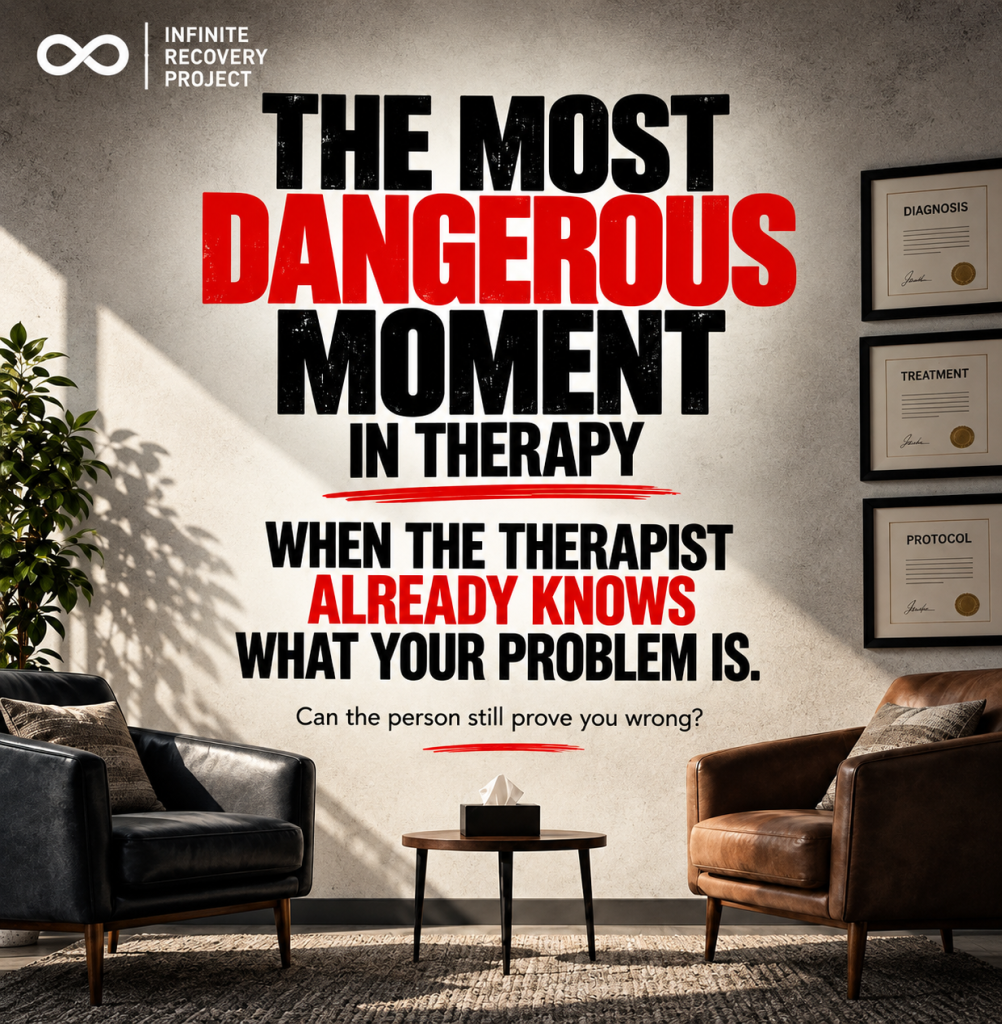
The Most Dangerous Moment in Therapy is…

is when the therapist already knows what your problem is!! Not when they get something wrong That can be corrected The dangerous moment is when they stop being available to discover that they might be wrong You mention addiction They already know it’s a disease Or trauma. Or attachment Or dopamine Or childhood neglect Or avoidance Or defects of character Or a nervous system problem Or whatever explanation they were trained to see And then something subtle happens The questions start serving the explanation Your answers are interpreted through it What fits is noticed What doesn’t fit needs explaining away If you agree, the model is confirmed If you disagree, perhaps you lack insight If treatment works, the model worked If it doesn’t, perhaps you weren’t ready Eventually the person can no longer prove the explanation wrong And at that point I’m not sure we’re doing therapy anymore We’re fitting a human being into something we already believe I know this because I’ve done it For years, I believed I understood addiction because I had lived it, recovered from it and spent decades around recovery I had answers A lot of them What I had much less of was the ability to sit with someone and genuinely not know Today I begin somewhere different I may have ideas I may have experience I may notice patterns I may even have a strong orientation towards seeing behaviour as intelligent adaptation rather than defect But none of that gives me the right to decide what another person’s experience means The person still has to be able to prove me wrong Maybe that is one of the simplest tests of any helping relationship: Can the person in front of you still change your mind about them? If not, you may no longer be listening You may just be looking for confirmation

Guidance, Professionals, Recovery

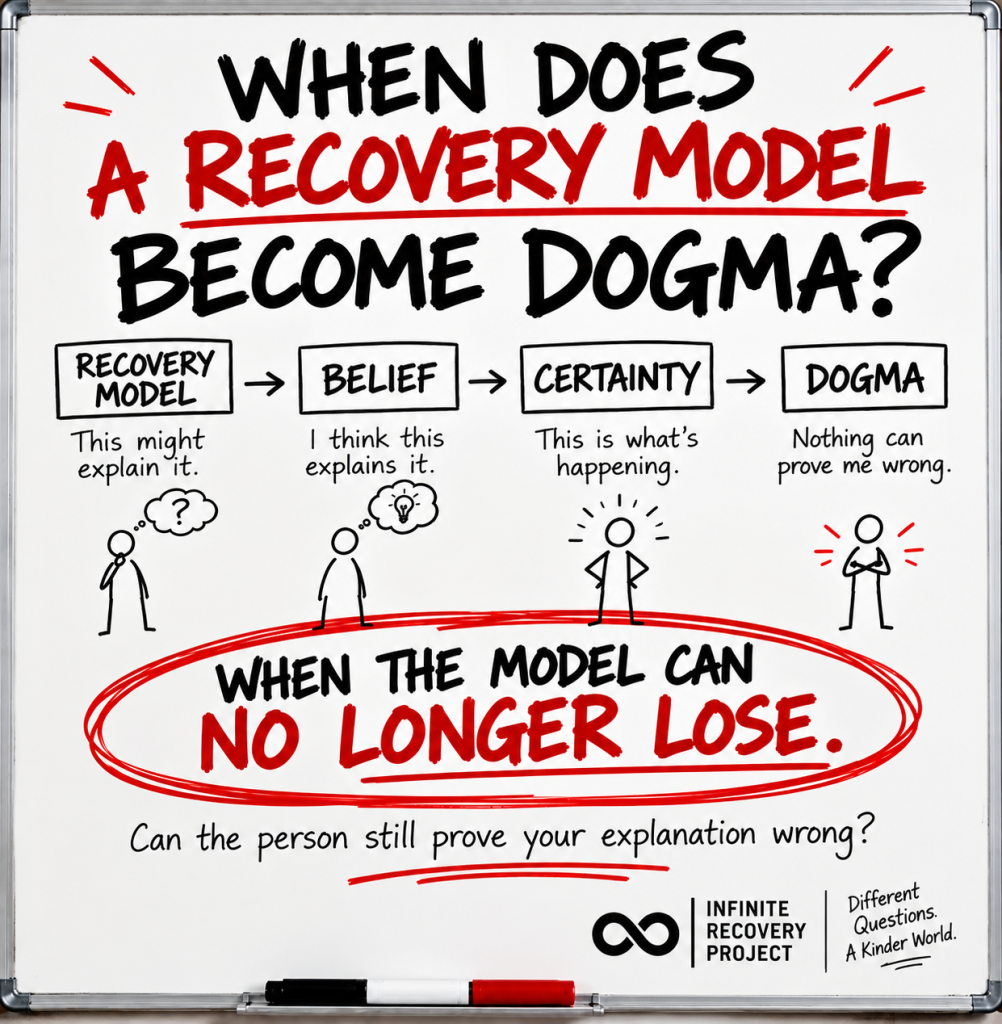
IF YOUR RECOVERY MODEL CANNOT BE QUESTIONED, IT IS NOT A MODEL ANYMORE!

It’s a belief system… Every model begins as a possibility A way of making sense of something – A lens – A framework – A hypothesis “This might help me understand what I’m seeing” But something strange can happen over time The model works It helps people We study it We teach it We build communities around it Maybe it saved our own life And slowly… “This might explain something” becomes… “This is what is happening” Then the model becomes harder to question If someone agrees with it, that confirms the model If they disagree, perhaps they lack insight If the treatment works, the model was right If it doesn’t work, perhaps the person wasn’t ready If they reject the programme, perhaps they’re resistant If they relapse, perhaps they didn’t surrender enough If they question the disease model, perhaps they’re in denial If they don’t identify trauma, perhaps they haven’t recognised it yet If they question the spiritual explanation, perhaps they’re closed-minded Eventually, everything becomes evidence for the model! And at that point the model can no longer lose That is where I think something important changes The problem is not that the model is necessarily wrong It may contain enormous truth It may have helped millions of people It may have saved your life The problem is that the person in front of you is no longer capable of proving it wrong  That is the danger And this applies to all of us – 12 Steps – Disease theory – Trauma – Attachment – Neuroscience – Psychodynamic theory – Spirituality Even my own belief in the intelligence of human adaptation I begin from a deep trust that there is something here that makes sense But if I decide in advance what that intelligence means, or what somebody’s behaviour must be doing for them, then I have done exactly what I criticise others for doing My model has stopped helping me inquire It has started telling me what I am going to find For me, the question is becoming very simple: Can the person still show me that my explanation of them is wrong? If the answer is yes, perhaps I’m still using a model If the answer is no, perhaps the model is using me And maybe that is when a framework stops being a tool for understanding and becomes something much closer to dogma

Guidance, Professionals, Recovery

What Saved You May Also Blind You to The Next Person

Some of the people I disagree with most in recovery have enormous hearts They genuinely want to help They’ve found something that changed their life, the 12 Steps, therapy, trauma work, spirituality, religion, coaching, Tony Robbins, neuroscience, whatever it happens to be And something very human can happen next It worked for me becomes This is what works! Then Other people need this! And eventually If they aren’t getting better, they haven’t understood it, surrendered to it, worked it properly, become ready, committed enough, or found the right version of it yet That is the moment passion can quietly become dogma And it’s difficult to see because the intention can remain completely loving Someone can devote their life to helping people while becoming increasingly certain that they understand what those people need I’ve done it myself! For years I believed passionately in the 12 Steps because they had helped me stop using drugs. I wanted other people to have what I had found My heart wasn’t the problem I understood too soon I mistook something that had helped me for knowledge about somebody else And “but it saves lives” doesn’t resolve this Something helping one person, or thousands of people, tells us that it can help people It doesn’t tell us why it helped every person it helped It doesn’t tell us who it won’t help It doesn’t tell us what else might have helped And it certainly doesn’t give us the right to organise another human being’s experience around its explanation This is how movements become evangelical A transformation happens A story forms around the transformation The story becomes a method The method becomes an answer The answer becomes an identity And eventually questioning the answer feels like questioning the transformation itself That’s where curiosity becomes very difficult I don’t want less passion in recovery I want passion with humility Bring your experience, bring what saved you, bring your training, research, spirituality and everything you’ve learned Just leave enough space for the person standing in front of you to show you that none of it explains them Perhaps the greatest respect we can give something that changed our life is not insisting that it should change somebody else’s in the same way

Guidance, Professionals, Recovery

The People on the Stage Speaking – Probably Already Agree With the People Who Built The Stage

I’ve been thinking about something uncomfortable again.. Go to a 12-Step convention Who gets invited to speak? Usually someone with a powerful story that confirms the value of the 12 Steps Their story moves the room, everyone applauds And another room full of people leaves with their existing understanding of recovery strengthened But think about who probably wasn’t invited… The person who did everything they were told, stayed abstinent for twenty years, and eventually began questioning whether the programme had actually brought them freedom Now take the 12 Steps out of it Go to a trauma conference, Who gets invited onto the stage? Go to a psychotherapy training, Who decides which theories become part of the curriculum? Submit a new model to an organisation, Who decides whether it deserves attention? Even here on LinkedIn, the same thing is happening everywhere! Eventually in this something strange happens, we look around and see our beliefs being confirmed everywhere And we call that evidence But some of it may simply be selection The people choosing the speakers already have beliefs The people designing the training already have beliefs The people deciding which research questions deserve funding already have beliefs The algorithms learn what we respond to And we naturally gravitate towards people who make sense of the world in ways that make sense to us None of this requires conspiracy, and nobody has to be dishonest! In fact, everyone involved can be completely sincere That’s what makes it so interesting A system can become incredibly good at reproducing its own understanding of reality without anyone consciously deciding to silence another one And then the people most successful within that system may be the people who articulate its existing assumptions most convincingly Their success becomes evidence for the system Their visibility becomes evidence for the system Their qualifications become evidence for the system The applause becomes evidence for the system And eventually – “Everyone knows this” But who exactly is everyone? And who never got the microphone? I’m beginning to think one of the most important questions we can ask of any belief system including my own isn’t How much evidence confirms this? It’s Where could I encounter the evidence that contradicts it? Because if the people, institutions, training, conferences and algorithms surrounding me continually select for what I already believe… I could spend my entire life being proven right And still be wrong

Guidance, Professionals, Recovery

Philip Seymour Hoffman Relapsed After 23 Years, That Still Doesn’t Prove Addiction is a Disease

His death was tragic His return to drug use was real The consequences were catastrophic But none of that tells us what addiction fundamentally is Hoffman’s relapse has been used for years as evidence that addiction remains present even through decades of abstinence – dormant, waiting, progressing, ready to return, you may have read the recent post I commented on about it, where I was attacked by multiple people for stating the obvious So let’s think about the logic We observed a behaviour return…. Then we used the explanation we already believed in to tell us why it returned… Recurrence is evidence of recurrence It is not automatically evidence of a lifelong disease that existed invisibly for the previous 23 years Perhaps that explanation is correct Perhaps it isn’t But Hoffman’s death cannot prove it, that’s the point And I think we owe someone who can no longer tell us about his own experience more than turning his death into confirmation of whatever recovery philosophy we already believed, I see this as a very poor etiquette So… If remaining abstinent supports the model, and eventually returning to drugs also supports the model, what outcome could ever show us that the model was wrong? It simply cannot be that, it could never be wrong, imagine that….

Guidance, Professionals, Recovery

RECOVERY CAN KEEP YOU SICK

I spent 22 years in recovery It helped me stop using drugs It gave me community, structure and a completely different life I’m grateful for much of it But there was an idea underneath almost everything I learned I would always be an addict I could recover, grow, stay clean for decades I could build a family, a career and a meaningful life But I could never actually be free of addiction At best, I could manage it, One day at a time!! Keep doing the work, and don’t become complacent Remember what you are, because the disease is patient! It’s waiting for you… doing press ups And here’s the question that eventually became impossible for me to ignore What if I actually changed? Not learned to manage myself better Not became better at resisting urges Not accumulated more clean time What if the organisation of experience that once made drugs so important to me genuinely changed? because it did, I am not an addict, and I am free, cured of addiction fully and have been for 10 years now, even though I have been clean almost 32 years, I still was in addiction for the first 22! Was my recovery framework capable of recognising that? no! it (meaning people)reinterpreted my freedom as dangerous complacency! it is installed into newcomers!, people who leave, die! That’s where I think recovery itself can become a trap Not because meetings are bad Not because abstinence is bad Not because ongoing support is bad But because an explanation that once saved your life can become an identity you are never permitted to outgrow Imagine being told after 30 years of profound change You’re still what you were You just manage it successfully… And if you question that?!? That might itself be evidence that your disease is talking Notice the problem The identity becomes almost impossible to escape Accept it → you’re recovering Question it → you’re in denial Remain abstinent → recovery is working Use again → proof you were never free Where is the door out? I don’t think everyone needs to leave recovery I don’t think everyone should drink or use drugs again I don’t think everyone should abandon an identity that gives their life meaning, connection and safety I’m asking something much simpler Are we allowed to get well? like really? Not according to a programme According to the person actually living the life Maybe recovery should ultimately make itself unnecessary Maybe the greatest outcome isn’t becoming exceptionally good at being “in recovery” it’s reaching a point where your life is no longer organised around addiction at all Not fighting it, managing it, not proving you’ve defeated it Just living!! Recovery isn’t supposed to become your life! it’s supposed to give your life back!

Guidance, Professionals, Recovery

SOMETIMES RELAPSE IS EVIDENCE THAT RECOVERY FAILED

Someone enters treatment They’re told they have a chronic, relapsing condition They stop using They attend meetings Work a programme Learn their triggers Manage their cravings Build their life around recovery Then, five years later, they return to using And something strange happens Almost immediately, the explanation turns towards them Their disease was still there They became complacent They stopped doing what worked They lost connection They weren’t vigilant enough They didn’t prioritise their recovery Maybe….. But there is another possibility we seem far less willing to consider Maybe what we gave them wasn’t enough!! Maybe abstinence changed the behaviour without changing whatever made that behaviour necessary Maybe they became extraordinarily good at managing themselves without becoming fundamentally freer Maybe the explanation we gave them never adequately understood their experience in the first place Maybe the intervention worked exactly as designed, and what it was designed to achieve wasn’t enough I spent 22 years in recovery For much of that time, if somebody returned to using, I knew how to explain it I rarely remember asking whether we might have failed them That’s uncomfortable now… Because the prevailing logic has an extraordinary protection built into it If the person remains abstinent, recovery worked If the person returns to using, their disease progressed The system gets the success –  The person gets the failure I’m not suggesting every relapse means treatment failed That would simply replace one certainty with another I’m asking why treatment failure isn’t routinely considered as one of the possibilities In almost every other area of healthcare, if an intervention repeatedly fails to produce the outcome we hoped for, we examine the intervention In addiction, we have become remarkably comfortable examining the patient Perhaps returning to use doesn’t automatically tell us something about the chronicity of their disease Perhaps sometimes it tells us something about the limits of our understanding And perhaps the question after someone returns to using shouldn’t immediately be: What did they stop doing? Maybe we should also have the courage to ask What did we fail to understand?

Scroll to Top