Work with Us

Infinite Recovery Project 2025

Guidance

Guidance, Professionals, Recovery

Addiction is Really Not That Complicated

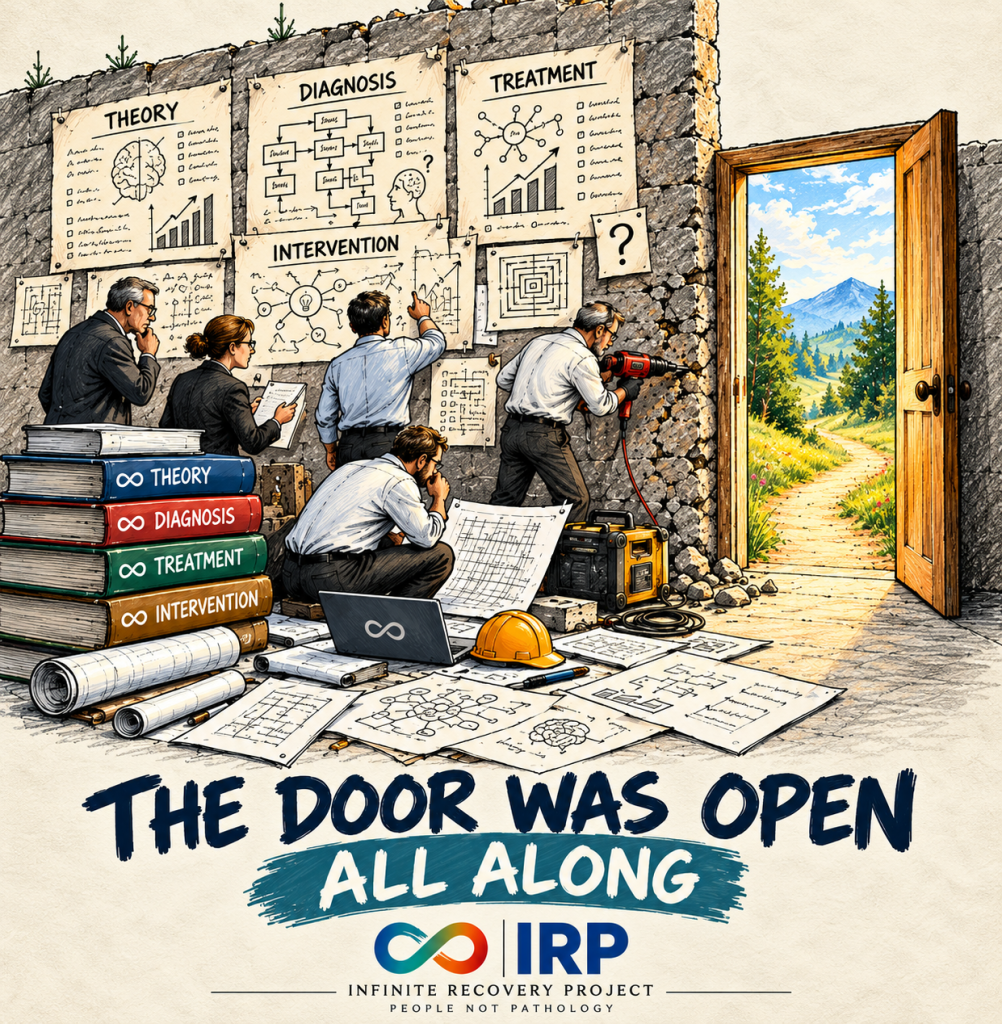
We seem endlessly fascinated by finding the next complicated solution to human suffering Another model. Another theory. Another diagnosis. Another intervention And the more sophisticated the explanation, the more intelligent we feel But what if all this complexity is sometimes serving the ego of the person trying to help, rather than the person suffering? We become so invested in what we know that we’re unwilling to look in a genuinely new direction Sometimes the most radical thing we can do is admit I don’t actually know what’s going on with this human being And begin there Not with another explanation Not with another solution But with the person Perhaps the answers aren’t always complicated Perhaps we’ve made understanding people complicated because we’re so reluctant to question what we think we already know

Guidance, Professionals, Recovery

The Most Important Question in Addiction Treatment, Maybe the One we Don’t Ask

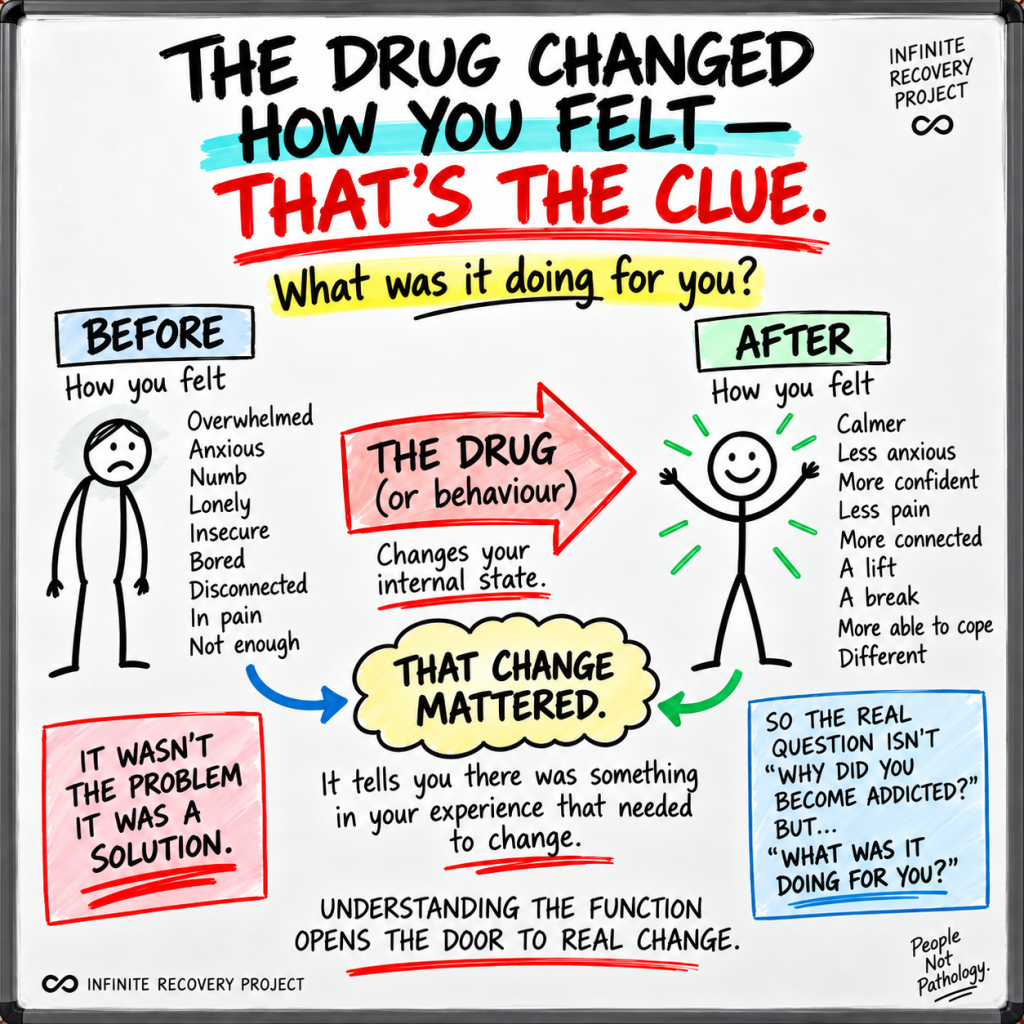
Someone takes a drug and something changes That much is obvious But we often become so focused on the drug, the diagnosis and how to stop the behaviour that we barely investigate the change itself What happened in that person’s experience? Not what does the disease model say happened Not what does trauma theory say happened Not dopamine Not attachment Not what happened for the last person we treated What actually changed for this person? Did something become quieter? Did they feel more alive? More connected? Less afraid? More confident? Did the world become bearable for a while? Or was it something I haven’t even thought to ask? That’s where I think addiction treatment can make a profound mistake We see the destructive consequences and conclude that the behaviour itself is simply the problem But human beings don’t repeatedly return to something for no reason Something changed! And whatever changed mattered enough that the person returned to it, despite consequences that may eventually have become devastating That doesn’t tell me what addiction is It gives me somewhere to become curious about Instead of beginning with “Why can’t you stop?” Try: “Show me what changed when you discovered this” And then resist the temptation to answer it for them Because the most sophisticated addiction model in the world can still prevent us from seeing the human being standing directly in front of us The person comes before the explanation People, not pathology

Guidance, Professionals, Recovery

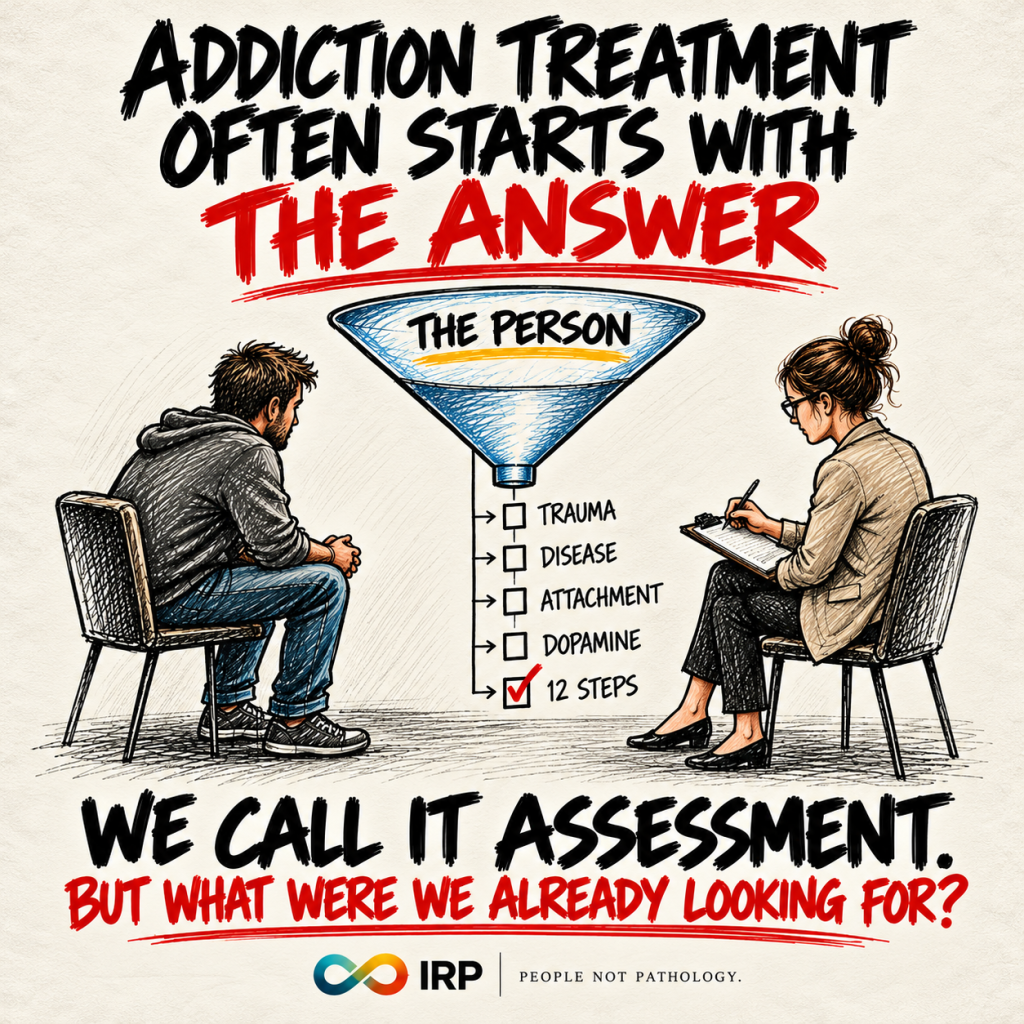
ADDICTION TREATMENT OFTEN STARTS WITH THE ANSWER

We like to think assessment is where we discover what is happening for someone But often, we’ve already decided what kind of answer we’re looking for If I believe addiction is a disease, I look for evidence of disease If I believe it’s trauma, I look for trauma If I believe it’s attachment, I look at attachment If I believe it’s dopamine and reward circuitry, I look at the brain If I believe the answer is the 12 Steps, I look for powerlessness, denial and willingness None of those things have to be wrong That’s not the point The problem begins when my explanation starts organising the conversation before I’ve understood the person Because even apparently open questions can contain answers “What trauma have you experienced?” “What are your triggers?” “What are you trying to escape from?” “What underlying issues haven’t you dealt with?” “What makes you powerless over this?” “What function does the addiction serve?” Each question directs attention somewhere And once we start looking there, we’re likely to find something Then something very subtle happens What we find becomes evidence that we were right to look there Trauma was found, so trauma explains it Triggers were identified, so triggers explain it Attachment difficulties appeared, so attachment explains it The person returned to use, so chronic disease explains it They resisted our interpretation, so they’re in denial We call this assessment But how much are we actually discovering? And how much are we confirming? I’ve become increasingly uncomfortable with how difficult it is to ask a question that doesn’t already contain some idea of the answer Even: “Why do you use?” may invite someone to produce an explanation rather than help us discover their experience Perhaps a more honest starting point is I know something important is happening here I don’t yet know what it is Show me! That requires something much harder from the professional than having the right model It requires being willing for our model to be wrong Because the person in front of us should always remain capable of showing us something we never thought to look for If they can’t, we’re no longer discovering them We’re discovering our model And calling it treatment

Guidance, Professionals, Recovery

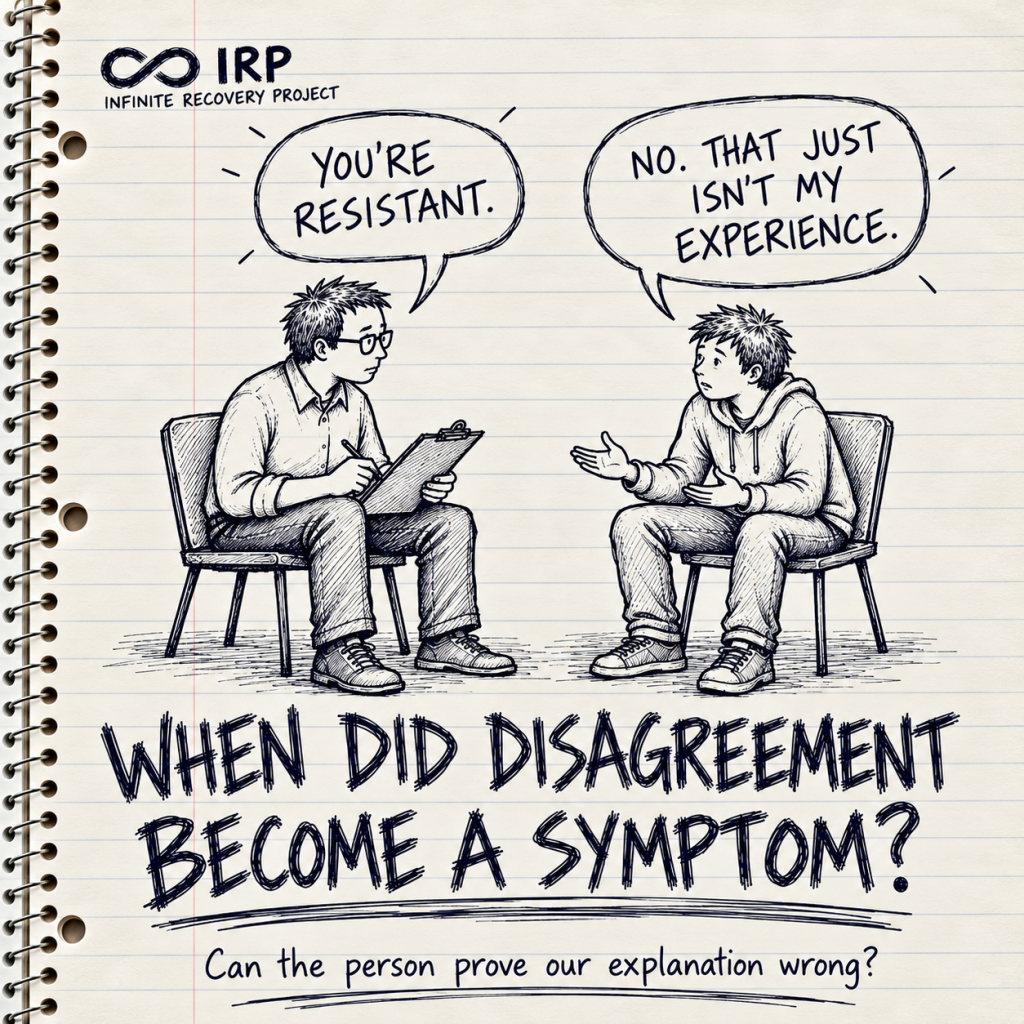
We Call it “Resistance” When the Person Resists Our Explanation of Them!

I’ve been thinking about this word a lot Resistant And the family of words that often sit beside it! – Denial – Non-compliant – Unmotivated – Not ready – Poor engagement – Lacks insight But sometimes I wonder what we’re actually describing Imagine someone enters addiction treatment We already have an explanation for what is happening to them – We have a model – An assessment – A treatment plan – An idea of what recovery should look like Then the person says: “That doesn’t make sense to me” And we say: “You’re resistant” They say: “I don’t think I’m powerless” Denial “I don’t want that treatment” Non-compliant “That isn’t why I use drugs” Lacks insight “I don’t want recovery to become my identity” Not engaging with recovery Look at what just happened!! Every disagreement became further evidence for the framework they were disagreeing with The model couldn’t lose And that’s what interests me I’m not suggesting resistance doesn’t exist I’m asking something much more uncomfortable: How do we distinguish resistance to change from resistance to our interpretation of the person? Because those are not the same thing If someone’s disagreement with our explanation becomes evidence that our explanation is correct, we’ve created a closed loop Perhaps sometimes the person isn’t resisting recovery Perhaps they’re trying to tell us: “You haven’t understood me yet” And maybe the most important thing we can do in that moment isn’t find a better intervention   It’s become willing to be wrong 

Guidance, Professionals, Recovery

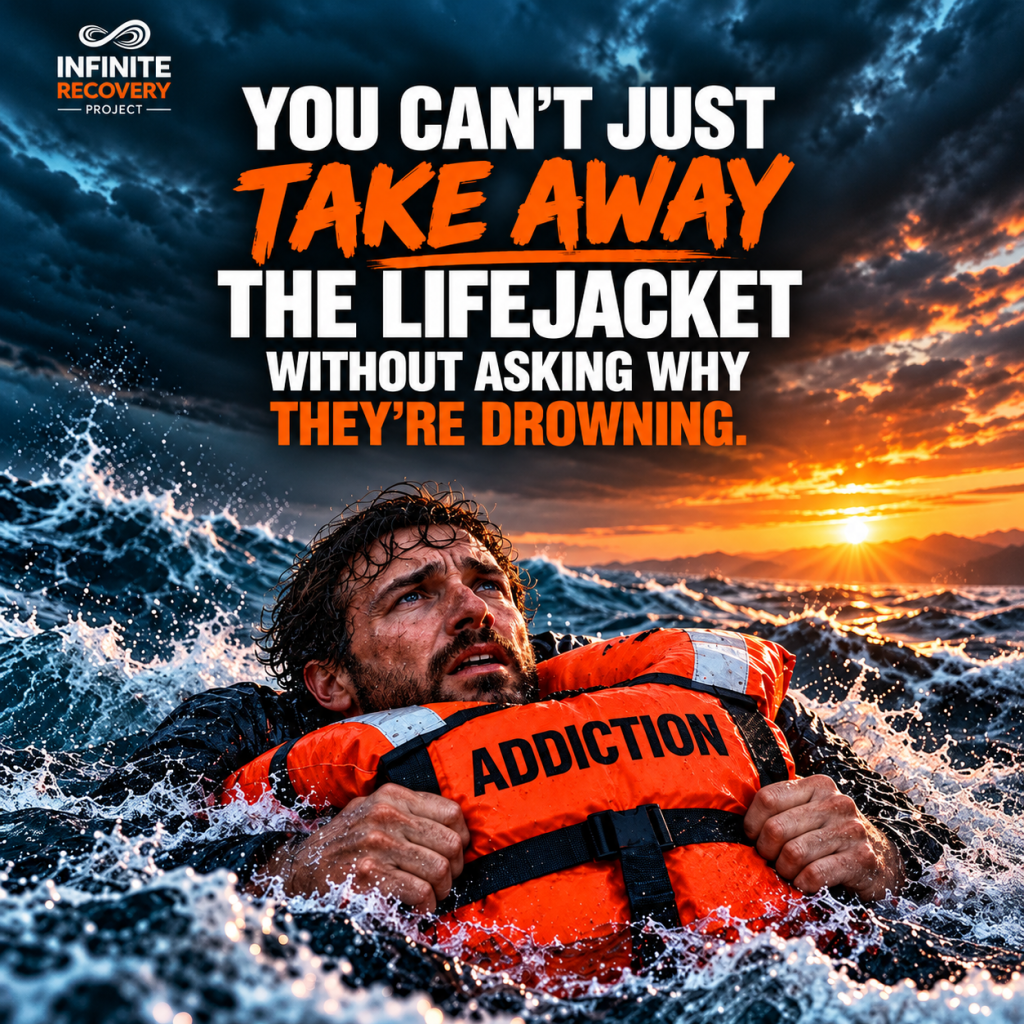
We keep telling people to let go of the very thing that may have been keeping them afloat

Stop drinking Stop using Stop gambling Stop escaping Of course the behaviour may be destroying their life now Yet that doesn’t tell us why they keep reaching for it What if, somewhere along the way, addiction became the thing that made an unbearable internal experience bearable? The thing that brought relief The thing that quietened everything for a moment The thing that helped them survive an experience they didn’t yet know how to carry Then simply taking it away leaves us with a very important question: What happens to the person when their way of staying afloat disappears? This is why I’m far more interested in understanding the function of addiction than condemning the behaviour Don’t just ask: “Why won’t they let go?” Ask “Why do they still need to hold on?”

Guidance, Professionals, Recovery

What Happens When We Are Shown the Limits of Our Own Thinking!?

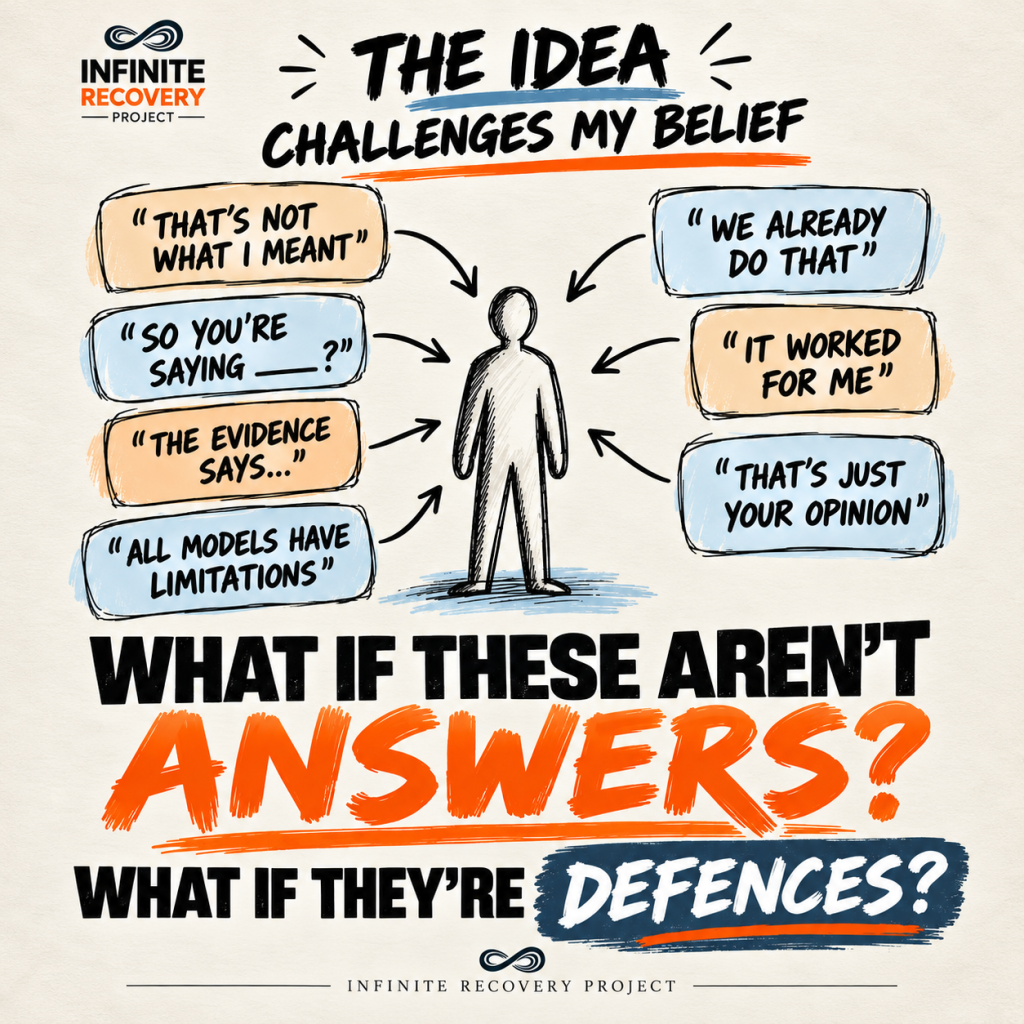
I’ve noticed something fascinating in the conversations underneath my posts When I question an assumption in addiction treatment, very rarely does the conversation simply stay with the assumption Something else happens Question whether lived experience gives us authority over another person: “So lived experience has no value?” Question whether trauma should be assumed: So trauma doesn’t matter? Question the disease model: So you’re saying addiction isn’t real? Question lifelong recovery: “So you’re telling people to stop doing what keeps them well?” Question whether our assessments actually discover the person: “But we already ask those questions” Question whether a model is organising what we see: “All models have limitations” And one of my favourites: “That’s what we already do” Sometimes the challenge gets exaggerated into something I never said Sometimes it gets absorbed into the existing model Sometimes the original claim quietly changes Sometimes personal experience becomes evidence Sometimes gratitude becomes evidence Sometimes credentials become evidence Sometimes the conversation moves from the question being asked to the person asking it And sometimes we agree with the challenge so completely that we don’t notice ourselves reproducing the very assumption being challenged in the next sentence “This is spot on. And here’s why what I already believed is still the answer” That’s perhaps the most interesting response of all! Because resistance to an idea doesn’t always look like disagreement Sometimes it looks like agreement that changes absolutely nothing I know this process because I’ve done it myself For years I could have told you I was open-minded while interpreting almost everything I encountered through what I already believed about addiction and recovery – I could ask questions – I could listen – I could care deeply And still never notice that my understanding was deciding what their answers meant THAT IS THE BLIND SPOT!! The mind is extraordinarily good at protecting an explanation without experiencing itself as protecting anything And perhaps that’s why genuine inquiry is so difficult It isn’t simply being willing to ask questions It is being willing to remain there when the answer threatens something we have invested years in believing – Our training – Our recovery – Our professional identity – Our model – Our expertise Even the story we’ve used to understand our own life So I’m becoming interested in a different question: What happens inside us when the person, or the evidence, doesn’t fit what we already believe? Do we become more curious? Or do we find a cleverer way of making them fit? Because perhaps the greatest limitation in addiction treatment isn’t that we don’t know enough It’s how difficult it is to see the moment that what we know has stopped us discovering anything new

Guidance, Professionals, Recovery

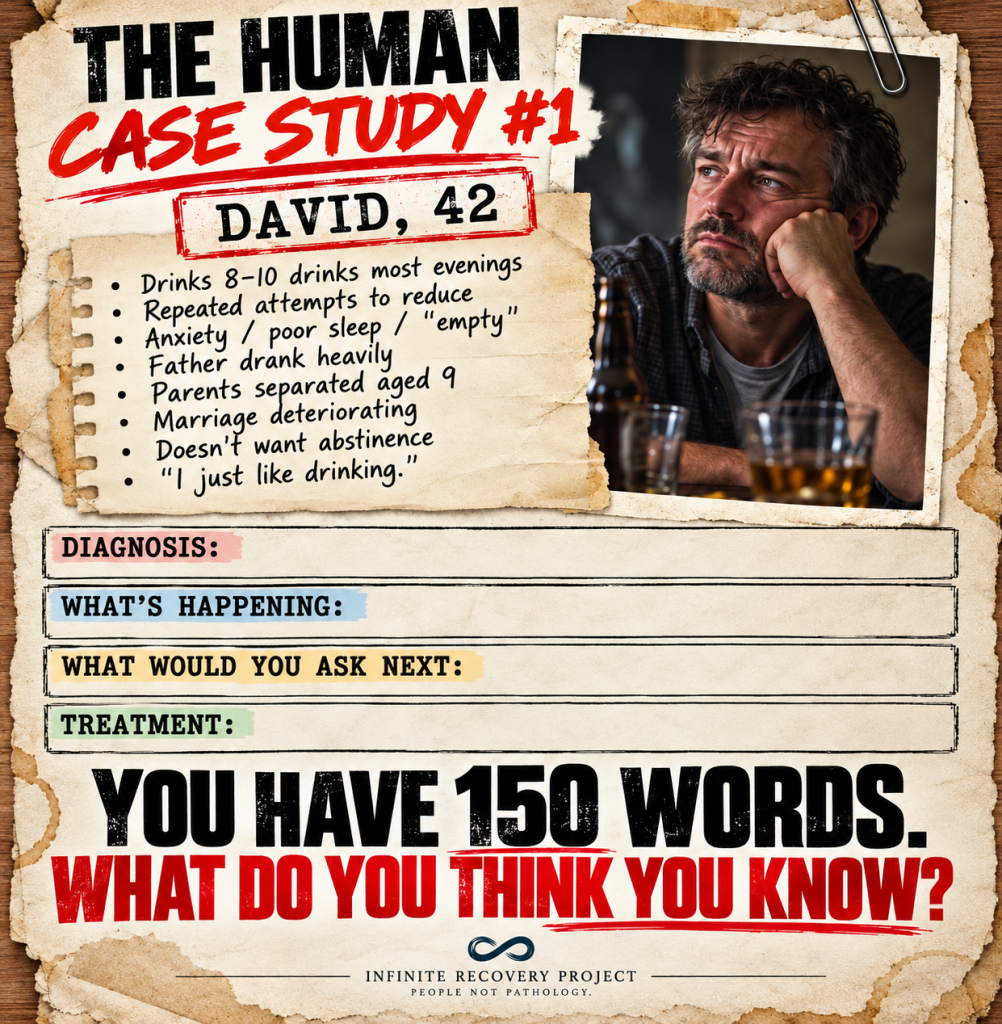
HUMAN CASE STUDY #1

David is 42 He drinks most evenings, usually beginning around 6pm Over the last three years his drinking has increased from 2- 3 drinks to approximately 8–10 He has tried repeatedly to reduce it and sometimes manages several weeks before returning to the same pattern His marriage is deteriorating. His wife has threatened to leave twice. He has begun missing occasional mornings at work He describes anxiety, difficulty sleeping and periods of feeling “empty” His father drank heavily and was emotionally unpredictable. His parents separated when he was 9 David describes his childhood as “fine” and says he doesn’t believe it has anything to do with his drinking He says “I don’t know why everyone makes this so complicated. I just like drinking” He doesn’t want abstinence. He wants to “get it under control” You’re meeting David for the first time What do you think is happening? What would you want to know next? And what would you recommend? Therapists, psychiatrists, addiction workers, psychologists, recovery professionals, peers – I’m genuinely interested..??

Guidance, Professionals, Recovery

What We Tell Vulnerable People When They’re Desperate for an Answer

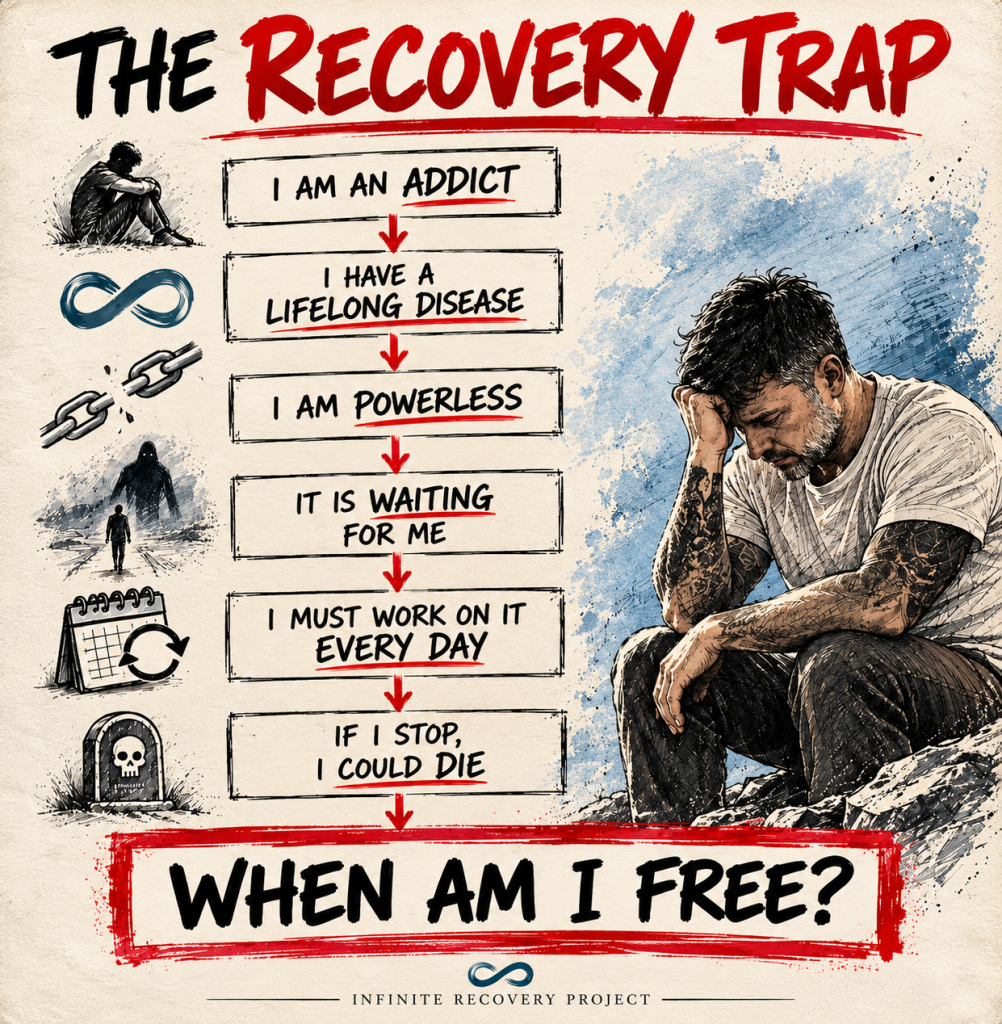
Imagine meeting someone at one of the most frightened, confused and desperate moments of their life They can’t stop drinking They can’t stop using Their family may be falling apart They may have lost their job, their home, their relationships or any sense of who they are They want one thing An answer! And desperate people will often believe answers they would question under different circumstances So what do we tell them? “You are an addict” “You have a lifelong disease” “You are powerless” “You’ll always have this” “It’s waiting for you” “You need to work on your recovery every day” “If you stop doing what keeps you well, you could relapse” “You could die” Then something extraordinary happens (or not) The person gets better They stop using Their life changes Five years pass Ten years. Twenty years Thirty years And we are still be asking them to understand themselves through the explanation they were given during one of the most vulnerable periods of their life I spent 22 years inside that understanding So I’m not mocking it I’m asking whether we appreciate the responsibility involved in giving somebody an identity and an explanation of themselves when they are desperate enough to accept almost anything that offers hope Because some of these statements aren’t neutral facts They are beliefs about what addiction is, what the person is, what their future holds and what they will need for the rest of their life And beliefs have consequences!! Tell someone repeatedly that something dangerous lives inside them and they may spend their life watching for it Tell someone they are powerless and they may interpret struggle as evidence of powerlessness Tell someone recovery must be maintained forever and stopping can become frightening Tell someone relapse proves the disease is still there and relapse becomes confirmation Tell someone continued recovery prevents relapse and every year of abstinence becomes confirmation too Eventually almost anything that happens can prove the original explanation correct That’s the part I think we need to become much more uncomfortable about Because vulnerable people deserve help! They deserve safety! They deserve compassion! They deserve somewhere to belong! They also deserve intellectual humility from the people helping them! Maybe the most ethical thing we can sometimes say is I don’t know exactly what’s happening to you yet But I don’t believe you are broken And I’m not going to tell you who you are or what you will need for the rest of your life before we’ve even discovered what this has meant in yours Help someone through their darkest moment But be very careful about giving them a lifelong identity while they’re there They might still be carrying it 30 years after the crisis has gone!

Guidance, Professionals, Recovery

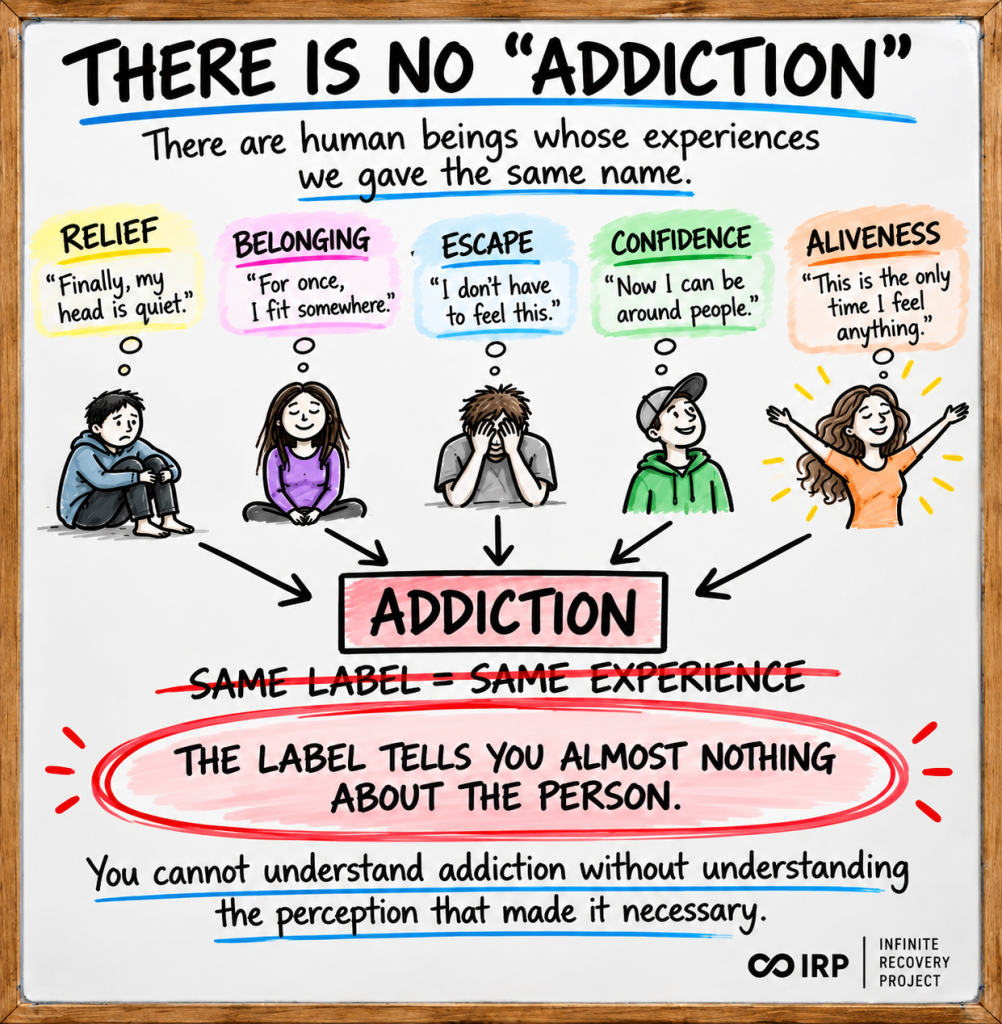
There is No Addiction, Really!

My last post – “Lived experience can make you worse at helping people” – created quite a reaction! But underneath it was a much bigger point There is no universal human experience called addiction  There are human beings having radically different experiences that we have placed under the same word Two people can use the same drug The same amount For the same number of years Experience the same withdrawal Lose similar things Receive the same diagnosis And what is actually happening for each of them will be entirely different Because nobody experiences drugs, relationships, fear, pleasure, loss, shame, their body, themselves, or the world, directly and identically! Everything is encountered through perception And perception isn’t some neutral camera recording reality It is already organised through everything that has shaped this particular human being learning, memory, relationships, biology, culture, expectation, meaning, previous experience and the state they are in right now Which means the drug itself never has one psychological meaning – For one person it may create silence – For another, belonging – For another, intensity – For another, distance – For another, confidence – For another, simply a way of making the next hour bearable And even those descriptions don’t tell us why that experience became necessary for that person This is why I increasingly struggle with statements like Addiction is caused by trauma Or dopamine Or genetics Or attachment Or childhood Or social deprivation Or an addictive personality These things may be relevant, often they are But the moment we turn any of them into the cause, we have taken something discovered across people and imposed it back onto the individual There is no route from an event to an addiction that bypasses the person experiencing it And this is exactly why neither lived experience nor education gives us the answer My addiction taught me about my addiction A PhD may teach someone an enormous amount about addiction as a field of study Neither tells us what this behaviour means in the life of the human being sitting opposite us We have to discover that Perhaps the greatest mistake in addiction treatment has been assuming that because we gave millions of profoundly different human experiences the same name, we discovered the same thing We didn’t We created a category! The person still has to be understood

Guidance, Professionals, Recovery

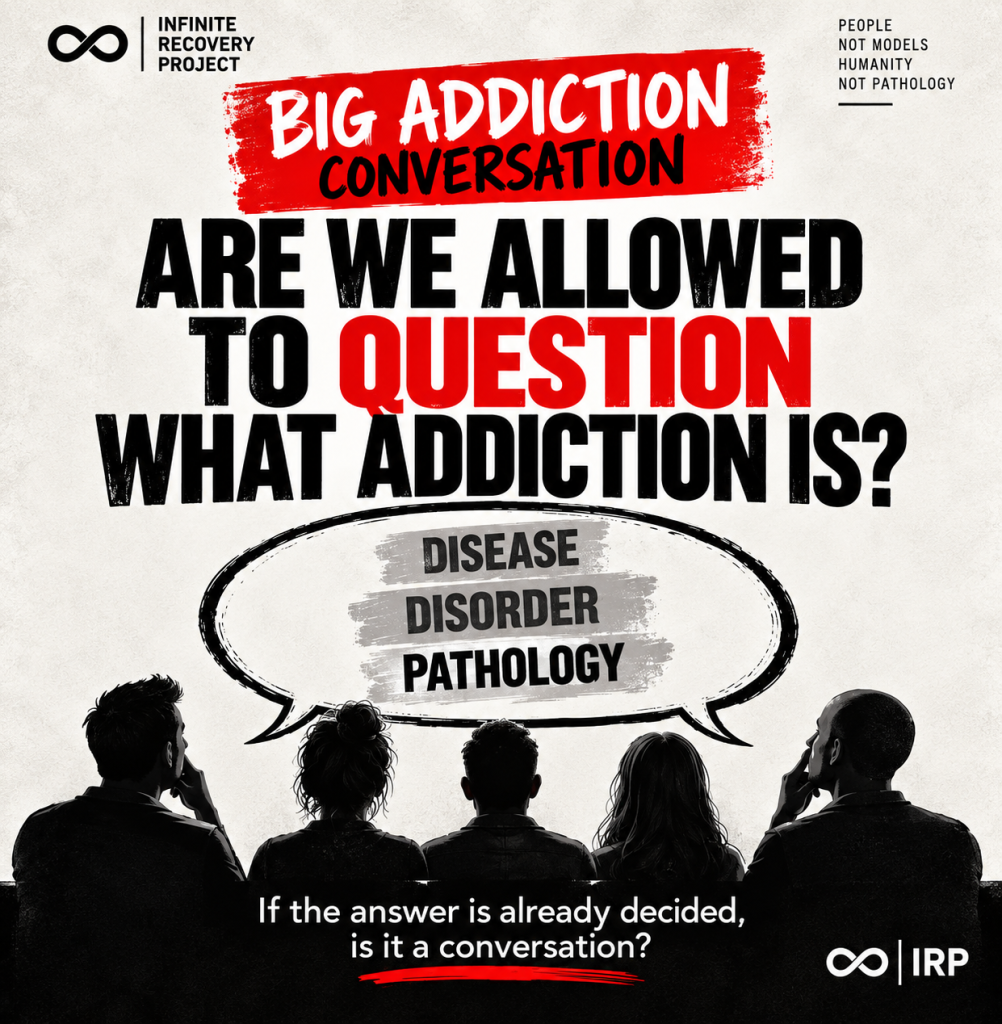
The Big Addiction Conversation sounds important. My question is whether the conversation is actually open?

Taking Action on Addiction and The Forward Trust are launching a national campaign aiming to start 17,000 conversations about addiction, one for every life lost each year to alcohol or drug-related causes in the UK! On the surface, I support the intention completely. Addiction needs far more public conversation, far less shame, and far more understanding The difficulty is that their own material appears to begin with conclusions that are already settled Taking Action on Addiction describes addiction as a “serious mental health condition” The Forward Trust’s recent material acknowledges that the disease and medical conception of addiction is contested, while still ultimately framing addiction as a well-established mental health condition and describing addictive behaviour as pathological That raises a question I think matters enormously What are the 17,000 conversations actually allowed to question? Can we question whether addiction is best understood as a disease or disorder at all? Can we ask whether behaviours we call pathological may sometimes be highly intelligent adaptations to unbearable internal experience? Can we question treatment systems that still organise people around lifelong identities, maintenance, relapse management and the assumption that the person remains fundamentally vulnerable to addiction? Can we ask why, despite decades of treatment models, services and awareness campaigns, UK drug and alcohol deaths remain so devastatingly high? And perhaps most importantly Can the conversation change the model, or is the model determining the conversation before it begins? I have spent decades around addiction personally and professionally. I spent 22 years inside 12-step recovery, have been drug-free for more than three decades, now work therapeutically with addiction, and have written extensively about a very different way of understanding it My concern with much of the UK addiction field is not that people don’t care My concern is that we keep having conversations from inside the same conceptual assumptions and calling that progress There is also an uncomfortable institutional question does The Forward Trust financially benefit from addiction being understood as disease, disorder or pathology? If an organisation is funded within the system, can it genuinely lead an open inquiry into whether the assumptions underpinning that system are wrong? If we really want a national conversation about addiction, the conversation has to be capable of questioning the foundations of how addiction is understood MIKE TRACE Otherwise it’s not an inquiry It’s an exposure campaign!

Scroll to Top