

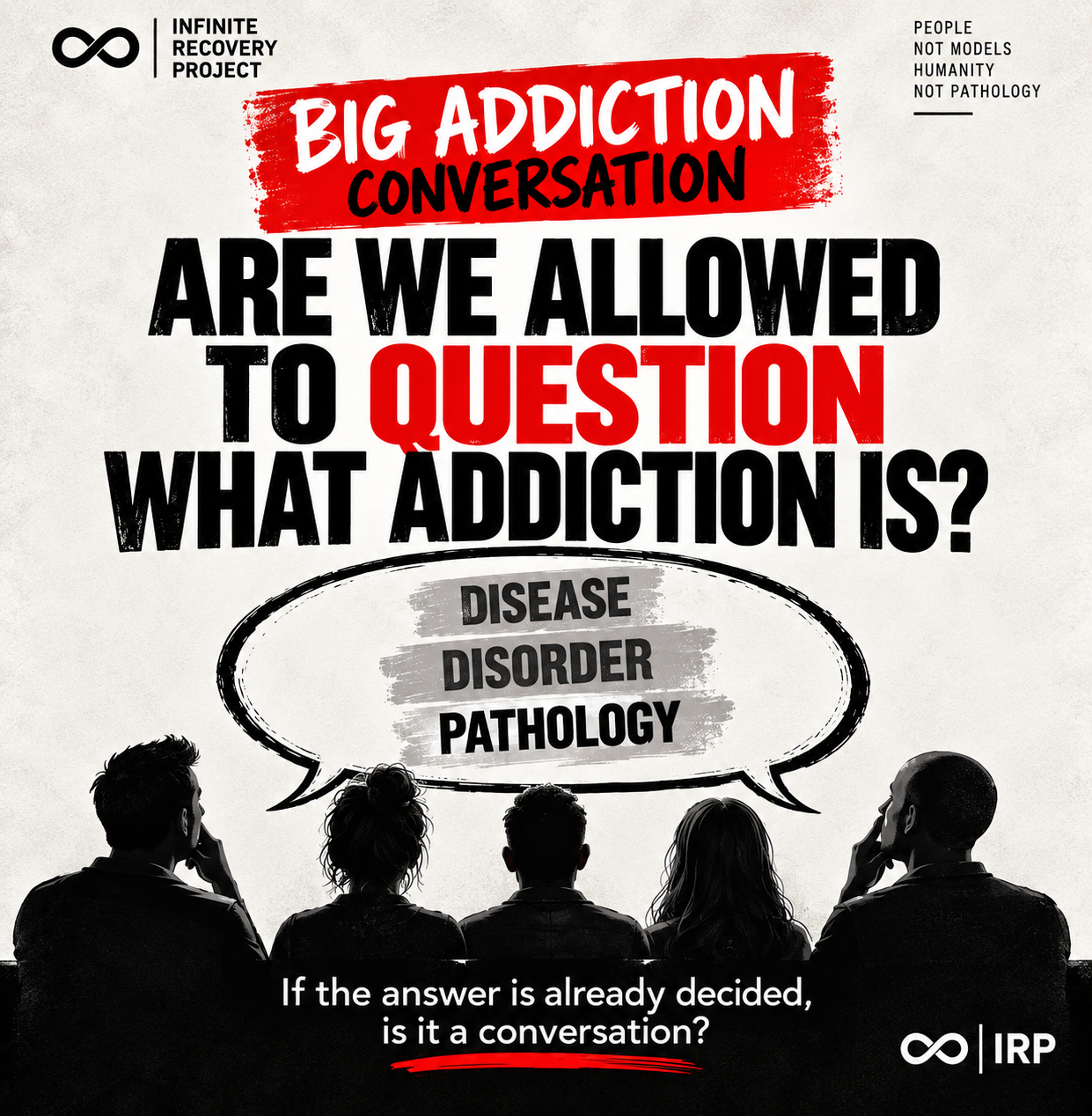
The Big Addiction Conversation sounds important. My question is whether the conversation is actually open?
Taking Action on Addiction and The Forward Trust are launching a national campaign aiming to start 17,000 conversations about addiction, one for every life lost each year to alcohol or drug-related causes in the UK!
On the surface, I support the intention completely. Addiction needs far more public conversation, far less shame, and far more understanding
The difficulty is that their own material appears to begin with conclusions that are already settled
Taking Action on Addiction describes addiction as a “serious mental health condition”
The Forward Trust’s recent material acknowledges that the disease and medical conception of addiction is contested, while still ultimately framing addiction as a well-established mental health condition and describing addictive behaviour as pathological
That raises a question I think matters enormously
What are the 17,000 conversations actually allowed to question?
Can we question whether addiction is best understood as a disease or disorder at all?
Can we ask whether behaviours we call pathological may sometimes be highly intelligent adaptations to unbearable internal experience?
Can we question treatment systems that still organise people around lifelong identities, maintenance, relapse management and the assumption that the person remains fundamentally vulnerable to addiction?
Can we ask why, despite decades of treatment models, services and awareness campaigns, UK drug and alcohol deaths remain so devastatingly high?
And perhaps most importantly
Can the conversation change the model, or is the model determining the conversation before it begins?
I have spent decades around addiction personally and professionally. I spent 22 years inside 12-step recovery, have been drug-free for more than three decades, now work therapeutically with addiction, and have written extensively about a very different way of understanding it
My concern with much of the UK addiction field is not that people don’t care
My concern is that we keep having conversations from inside the same conceptual assumptions and calling that progress
There is also an uncomfortable institutional question does The Forward Trust financially benefit from addiction being understood as disease, disorder or pathology? If an organisation is funded within the system, can it genuinely lead an open inquiry into whether the assumptions underpinning that system are wrong?
If we really want a national conversation about addiction, the conversation has to be capable of questioning the foundations of how addiction is understood MIKE TRACE
Otherwise it’s not an inquiry
It’s an exposure campaign!