Work with Us

Infinite Recovery Project 2025

Recovery

Recovery, Spirituality

A Paradigm Shift in Recovery – From “Me” to Freedom

Recovery, as it’s commonly understood, is often about fixing a broken self — a separate “me” navigating an objective world. The “I” becomes the centre of our universe, wrapped in stories of victimhood, survival, or triumph. Therapy, 12 steps, self-help… they all point us toward rearranging our inner world, like moving chairs around on the Titanic. Sure, the view might improve, but the ship is still sinking. The real transformation isn’t in fixing or even improving the narrative of “me.” The true shift comes when we stop identifying with it altogether. When we move from being the sufferer or survivor to realising that we are the observer — the knower of awareness, free from the narrative. This paradigm shift invites us to see beyond the relative world of “I need to be better, stronger, healed,” into the absolute — where peace already exists. The relative world of recovery, with its tools and techniques, is still tied to the idea of a separate self. It’s a vital step, yes, but it’s not the destination. True freedom is awakening to the fact that there is no “self” to fix, no story to heal. Addiction, trauma, therapy, and 12-step work all happen within the relative. They serve a purpose, yes — they stabilise us in the storm. But they cannot bring us true freedom because they reinforce the idea of a broken “me” needing repair. This is where the spiritual realisation arises: we are not the storm; we are the sky. This awakening is not an intellectual shift; it is the recognition of what has always been true. Trauma and spiritual insight dance together in this process. Trauma shows us where the self clings, where it suffers, where it resists. And spiritual awakening shows us that the self is an illusion. Recovery isn’t about reaching a destination or becoming “perfect.” It’s about stepping off the ship altogether. It’s about letting go of the search for a better “me” and seeing clearly the freedom and wholeness that already exist beyond the story. This is the paradigm shift the world of recovery needs. Not just better tools to manage suffering, but the radical realisation that the separate self is not who we are. The ship doesn’t need a new chair arrangement; we don’t need to cling to it at all. Be brave. Look beyond. Freedom isn’t a goal; it’s the truth of what you already are.
Guidance, Recovery

The Myth of Addictive Personalities

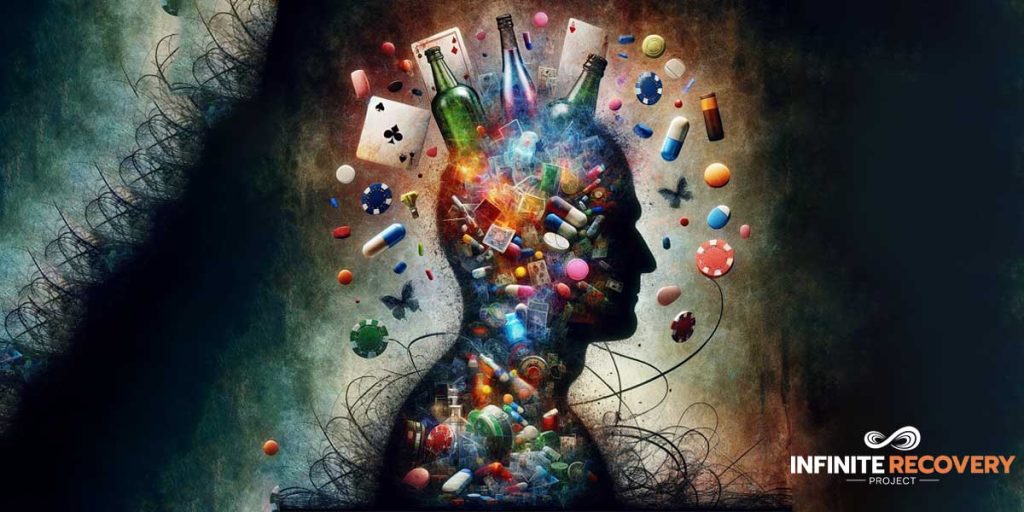
Have you ever wondered if you have an “addictive personality”? It’s an idea that’s been floating around for ages – this notion that some people are just “wired” for addiction, while others aren’t. But what if I told you that the concept of a fixed personality, let alone an “addictive” one, is just a myth? Let’s dig into this a bit. The belief that our personalities are set in stone, that we’re defined by a static, unchanging set of traits, can be comforting on one hand. After all, if our personalities are fixed, then maybe they’re something we can blame or rely on to explain our choices and behaviours. But the truth is, “personality” isn’t something you can find under a microscope. You won’t locate it in a brain scan or discover a part labeled “addiction” during surgery. Personality, as we think of it, isn’t a concrete thing; it’s a construct, a set of patterns and habits that we’ve come to believe define who we are. Science supports this idea too. Despite years of research, no one has found a specific “addictive personality type” that applies across the board to people struggling with addiction. The traits associated with addiction – impulsivity, sensation-seeking, emotional sensitivity, might show up in some people, but they’re not universally present. And many people who have those traits live perfectly healthy lives without addictive behaviour. Imagine lining up a diverse group of people – some with addictions, some without, and trying to spot a common thread in their personalities. You’d end up with a mix of traits, patterns, and quirks that don’t point to a clear answer. What’s more, these traits are often influenced by our experiences, our beliefs, and the society we live in. They’re not fixed parts of us; they’re fluid and subject to change over time. So, why does this matter? Because clinging to the idea of an “addictive personality” might actually limit us. If we believe we’re doomed by a certain personality type, it can make us feel powerless, like we’re at the mercy of our so-called nature. But when we start to see personality as something flexible and shaped by experience, we can open up new ways of understanding ourselves, and new ways of changing. We actually can see that the belief of a fixed personality type called ‘addictive personality’ will create the desired result – addictive behaviour, purely based on that belief, and nothing to do with any unexplainable phenomena or disease. Here’s something to think about: How much of the way you see yourself is based on patterns and beliefs you’ve simply accepted as “who you are”? Without question? And what might happen if you started to question them? Let me know your thoughts in the comments. Have you ever felt trapped by a label, whether it’s “addictive personality” or something else? Or do you have a story about challenging a part of your identity? I’d love to hear about your experiences and what they taught you.

Recovery, Spirituality

Success or failure

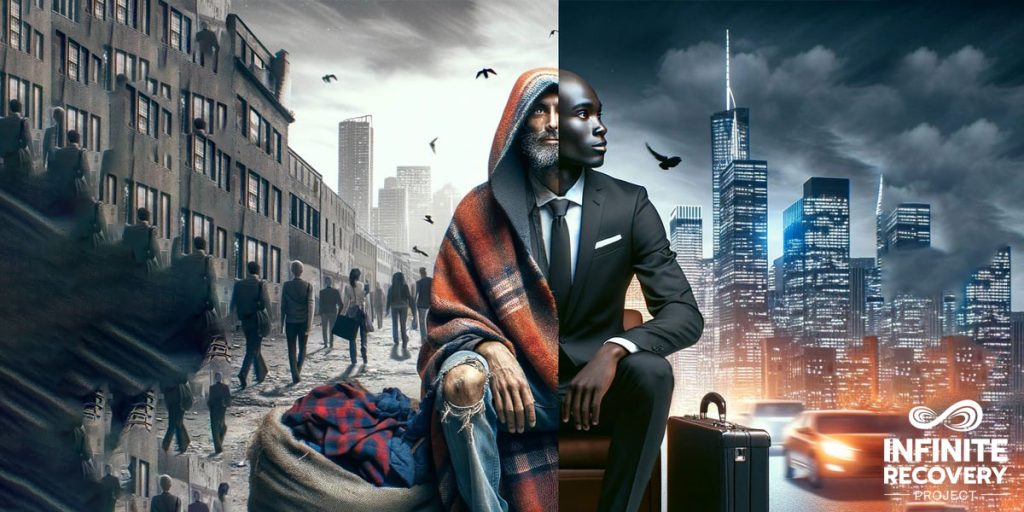
Look at your Facebook feed: ads gleaming with Lamborghinis and yachts, selling dreams dipped in luxury, 20 new high ticket clients a month etc. They poke at our insecurities, whispering, “This is what success looks like.” We’re lured in, believing that happiness is just a purchase away, that life’s worth is measured by the shine of our possessions or how many clients we have. This is the illusion that fuels our endless chase. The foundations laid down in a shitty childhood where we were never heard, told we would not be good enough, and vowed to show them our worth. So, picture an ad with a homeless man in a doorway, holding a plastic cup asking for change. No one’s buying that, right? It doesn’t sell the dream. It’s not aspirational. But why? Both the man in luxury, the Lamborghini and the man in rags are living their story, breathing the same air, experiencing the moment. Yet, we’re conditioned to crave one and disregard the other, to idolise wealth and success as society defines it, while turning a blind eye to what doesn’t sparkle. We’re conditioned to prove ourselves through our achievements, to offset our feelings of lack. This is the illusion — that one life is inherently more valuable or desirable than another based on material achievements. It drives us to strive endlessly, to climb ladders that lead to nowhere. We’re chasing a horizon that keeps shifting, believing that “just one more” achievement, purchase, or accolade will complete us. But in this relentless pursuit, what are we missing? The beauty of the present moment, the stories of those we consider “less” than successful, the simple joys that don’t cost a thing. These ads, these images of luxury, they don’t sell happiness; they sell a mirage, one that keeps us thirsty no matter how much we drink. This is a collective dream, which makes it more pervasive and you need balls to question the narrative. What if success isn’t about the car you drive but the lives you touch? What if wealth isn’t in your bank account but in your heart’s capacity to love, to empathise, to connect? To be your authentic self. If we truly look, with an open tender heart. We can find value in every person’s story, see the richness in diversity of experience, and redefine what it means to live a successful, fulfilling life. It’s not about the material trophies; it’s about the amount of kindness, resilience, and love you share no matter your circumstances.

Guidance, Recovery

Why experience of addiction doesn’t make you an expert

Thinking about expertise and experience, it’s easy to assume they go hand in hand. But let’s have a real look what’s going on. While experience is undeniably personal and significant, it doesn’t automatically make us an expert in a broader field, especially when considering the complex nature of subjective realities, and awareness. When we experience something, that experience is ours alone – filtered through our personal lens of beliefs, background, and emotion. It’s subjective, unique, and deeply personal. This perspective is what makes each person’s journey through life so rich and varied, but it’s also why our personal experience doesn’t universally translate into expertise. Claiming expertise based on our own experiences is like viewing the world through a keyhole and assuming we’ve seen the whole room. It disregards the vast spectrum of how others perceive and interact with a similar experience. Each person’s understanding is shaped by an intricate blend of personal history, culture, and individual psychology, creating as many versions of “truth” as there are people ie 8 Billion+ True expertise requires acknowledging and deeply understanding consciousness and multifaceted subjective realities. It involves continuously seeking out and understanding diverse experiences and perspectives, not just our own, if you want to be an expert in something, and you want to help others, make not knowing anything your top priority. It’s about recognising that while our personal journey is profoundly informative, it’s just one narrative in a world full of them. In essence, our experiences make us experts on our own lives, and no one else’s. In fact while you think your own experience is like anyone else’s as a source to help them, you will take them further away from healing. Silence can do a better job. Our role is simply to help someone uncover their own inner guide, and to be present and witness their transformation, via their own direct experience. Anything else is dogma, an indoctrination to a new belief system, and as humans we’re susceptible to falling in love with the next new shiny thing, including spiritual belief systems, concepts and theories of recovery. As always, I ask you don’t take my word for it, the information shared here is only valuable while you question yourself with it as a guide, my job is asking you to consider, is it true? could there be another way? could there? … maybe?

Recovery, Shame

Breaking Through the Shame of Asking for Help

The Shame of Asking for Help: Breaking Through the Illusion of Self-Reliance. I’ve seen it firsthand, the shame of asking for help. I’ve watched someone who had been struggling in silence for years, utterly convinced that reaching out for support was something to be ashamed of. They carried that belief so deeply, they were almost willing to end their life rather than ask for help. They thought needing support meant they were broken, weak, or beyond saving. The shame was so strong it nearly silenced them forever. And then, something changed. With what little strength they had left, they reached out. They asked for help. And what happened next was incredible – love, support, and understanding poured in. People who had been waiting, willing to offer compassion, were there in ways they hadn’t expected. The very thing they thought would isolate them brought connection. The very thing they were ashamed of led to freedom. But before that moment, they were completely convinced that asking for help was something to hide – a flaw in their character, a failure. Why? Because we’re conditioned that way. From childhood, we’re taught by watching others, by hearing the comments, the criticism: “Don’t burden others with your problems,” “Keep it to yourself,” “Be strong,” “Handle it on your own.” It’s ingrained in us, and we carry that programming into adulthood, convinced that self-reliance is strength and that vulnerability is a weakness. But here’s the truth: that shame you feel about asking for help? It’s not real. It’s just a projection of your mind, part of the story your conditioned identity is telling you. It’s part of the protection method that’s been created through years of trying to survive a world that told you your pain wasn’t important. Asking for help doesn’t make you weak. It takes immense strength to look at your situation, acknowledge that you can’t do it alone, and reach out a hand. That is resilience. That is courage. In fact, it’s one of the hardest things you’ll ever do, because you’re fighting against a lifetime of conditioning telling you to handle it yourself. Self-reliance works when we’re solving problems at work, or fixing something small in our daily lives. But when it comes to deep healing – healing from trauma, addiction, mental health struggles – self-reliance doesn’t work. We can’t heal in isolation because we aren’t meant to. We are wired for connection. We need others to help us process our pain, to give us perspective, to hold space when it feels like the world is collapsing around us. If you’re reading this and feeling the weight of that shame – the idea that asking for help means you’ve failed – I want you to hear this: Asking for help is not weakness. It is power. It is strength. And it is one of the bravest things you can do. It’s time to rewrite the story and understand that reaching out doesn’t make you less – it makes you more. More human, more resilient, more connected. Are you willing to let go of that shame? To reach out? To trust that you’re worthy of the love and support that’s waiting for you? #EndTheStigma #YouAreNotAlone #MentalHealthMatters p #AddictionRecovery #HealingTogether #BreakTheSilence #NoMoreShame

Scroll to Top