

What Happens When We Are Shown the Limits of Our Own Thinking!?
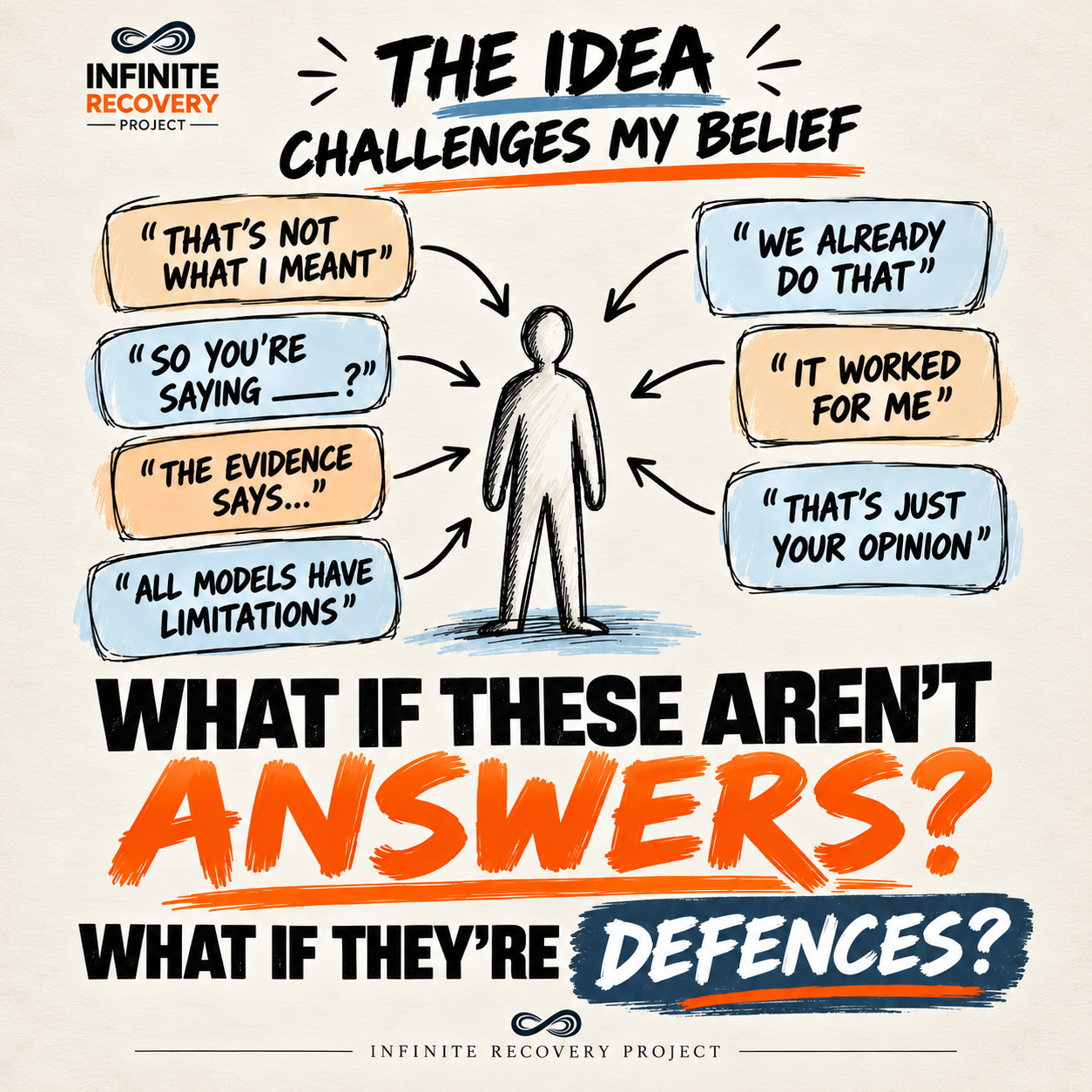
I’ve noticed something fascinating in the conversations underneath my posts
When I question an assumption in addiction treatment, very rarely does the conversation simply stay with the assumption
Something else happens
Question whether lived experience gives us authority over another person:
“So lived experience has no value?”
Question whether trauma should be assumed:
So trauma doesn’t matter?
Question the disease model:
So you’re saying addiction isn’t real?
Question lifelong recovery:
“So you’re telling people to stop doing what keeps them well?”
Question whether our assessments actually discover the person:
“But we already ask those questions”
Question whether a model is organising what we see:
“All models have limitations”
And one of my favourites:
“That’s what we already do”
Sometimes the challenge gets exaggerated into something I never said
Sometimes it gets absorbed into the existing model
Sometimes the original claim quietly changes
Sometimes personal experience becomes evidence
Sometimes gratitude becomes evidence
Sometimes credentials become evidence
Sometimes the conversation moves from the question being asked to the person asking it
And sometimes we agree with the challenge so completely that we don’t notice ourselves reproducing the very assumption being challenged in the next sentence
“This is spot on. And here’s why what I already believed is still the answer”
That’s perhaps the most interesting response of all!
Because resistance to an idea doesn’t always look like disagreement
Sometimes it looks like agreement that changes absolutely nothing
I know this process because I’ve done it myself
For years I could have told you I was open-minded while interpreting almost everything I encountered through what I already believed about addiction and recovery
– I could ask questions
– I could listen
– I could care deeply
And still never notice that my understanding was deciding what their answers meant
THAT IS THE BLIND SPOT!!
The mind is extraordinarily good at protecting an explanation without experiencing itself as protecting anything
And perhaps that’s why genuine inquiry is so difficult
It isn’t simply being willing to ask questions
It is being willing to remain there when the answer threatens something we have invested years in believing
– Our training
– Our recovery
– Our professional identity
– Our model
– Our expertise
Even the story we’ve used to understand our own life
So I’m becoming interested in a different question:
What happens inside us when the person, or the evidence, doesn’t fit what we already believe?
Do we become more curious?
Or do we find a cleverer way of making them fit?
Because perhaps the greatest limitation in addiction treatment isn’t that we don’t know enough
It’s how difficult it is to see the moment that what we know has stopped us discovering anything new