Work with Us

Infinite Recovery Project 2025

Recovery

We Need To Talk About
Guidance, Professionals, Recovery

We Need To Talk About The $40 Billion Dollar Reason Why Addiction Treatment Keeps Failing

The last post laid out why most addiction treatment doesn’t work, not because people don’t try, but because the system is built on flawed models. We are confusing compliance with healing Here’s the root cause of that failure, the revolving door is financially profitable The value of the addiction treatment sector is significant. High relapse rates, up to 50-70% within a year after many programmes (Kelly et al., 2020), which look like a failure on paper, are often an inherent feature of the business model Re-admissions sustain the industry This is not a conspiracy, it is the natural, ugly consequence of a profit-driven system built around symptom management, not root-cause resolution Think about what drives a system that prioritises short-term, 30-day stays and abstinence-only metrics The need for quick fixes – deep, trauma-informed, nervous system work is slow, nuanced, and intensive. It doesn’t fit neatly into an insurance or funding billing cycle, or a rapid detox timeline. Instead, we get models that address the addiction as a primary behaviour, completely bypassing the trauma history that is present in over 70% of clients (SAMHSA, 2022) Avoiding true healing: Acknowledging the role of systemic trauma and nervous system dysregulation means completely redesigning the model, something most large institutions won’t do if the current model is solvent. The emphasis on ‘powerlessness’ in many models can actually re-traumatise people by mimicking the disempowerment of earlier life events (Pagano et al., 2018) When the industry’s success is defined by filling beds and processing clients, its mission, lasting healing, is compromised The Solution: Shift the value from compliance to coherence,.. Stop defining recovery by a negative, what the person isn’t doing (using substances)…and start defining it by a positive: what the person is building (safety, connection, self-regulation) We have to shift the value proposition from brief, intensive crisis management to long-term, integrated, relational healing. We must reward outcomes that reflect lasting safety, not just clean drug tests This means prioritise safety and agency. Integrate the body (Somatic Work): without somatic integration, we are missing the mechanism by which safety is recorded (van der Kolk, 2021). Success must be measured by overall life quality, relational health, and nervous system resilience, moving beyond abstinence as the sole metric (Witkiewitz et al., 2021). Until we change the way success is measured and funded, we will keep punishing people with a system that has a vested interest in their return. The opposite of addiction is safety, and we cannot create safety in an unsafe or compromised economic environment. If you could force one policy change today to shift the incentives from ‘repeat business’ to ‘lasting healing’ in this sector, what would it be?We need to talk about the $40 billion addiction treatment industry-because despite all the money, it keeps failing to truly help people heal. Get the book: https://www.amazon.com/dp/1068323302

Guidance, Professionals, Recovery

Addiction Isn’t a Disease – It’s the Nervous System’s Best Idea

Many of us have been taught to see addiction as a malfunction… A brain disorder…. A defect in willpower or a failure of character…. And what if it’s none of those?? What if addiction is the most intelligent thing your nervous system could do at the time? Not intelligent like a strategy, or like, is it a good idea to put my hand in the fire intelligent… Intelligent like survival…. Like ‘I don’t know how to be with this pain, so I’ll find anything that gives me a moment’s relief’ And the body listens. Even if that ‘relief’ becomes the very thing that harms us. – We call it broken – We diagnose it – We medicate it – We build entire systems to fix it But Addiction is not the opposite of willpower….. It’s the echo of pain…. When you were young and no one came… When your system was flooded and there was no safety… Your biology did not ask for permission. It adapted, right there and then, in the moment Addiction wasn’t a choice, It was a response. And until we start seeing that, we’ll keep punishing what was once protection. We’ll keep calling survival ‘sickness’ And we’ll keep missing the doorway that could actually lead to healing. Because the opposite of addiction is not sobriety. It’s safety. Get the book: https://www.amazon.com/dp/1068323302
Guidance, Professionals, Recovery

If this Were Any Other Industry, It would Be Shut Down

We keep calling it treatment – but where is the healing? Behind the buzzwords of recovery and evidence-based care, there’s a reality we don’t talk about enough…Most addiction treatment doesn’t work – not because people aren’t trying hard enough, but because the system is built on outdated models, recycled ideas, and a misunderstanding of the problem and what healing really requires.Here are 10 well-documented failures in the addiction treatment industry – not as a takedown, but as a wake-up call:1. High Relapse Rates Post-Treatment Most programs have 50–70% relapse within a year. Kelly et al. (2020), Recovery Research Institute 2. Abstinence is Treated as the Only Success Metric Life quality, safety, and healing are rarely measured. Witkiewitz et al. (2021), Alcohol Research 3. Powerlessness Can Re-Traumatise People What’s healing for some may retraumatise others. Pagano et al. (2018), Journal of Substance Abuse Treatment 4. Trauma is Ignored or Outsourced 70%+ of clients have trauma histories, very few offer trauma-integrated care. SAMHSA (2022) 5. Overdose Risk Spikes Post-Rehab People leaving abstinence-only rehabs are at 3x higher risk of fatal overdose. Binswanger (2017); Sordo et al. (2020), BMJ 6. The Industry Benefits from Repeat Clients 40%+ re-admission to treatment = the revolving door is a business model. National Center for Health Statistics (2023) 7. Coerced Treatment Has Worse Outcomes Court-mandated rehab leads to lower engagement and long-term recovery. Werb et al. (2019), The Lancet Public Health 8. Therapy-Only Misses the Body Without somatic integration we miss the nervous system’s role in addiction. van der Kolk (2021); Frontiers in Psychology (2022) 9. Evidence-Based ≠ Effective Most evidence-based treatments track symptoms, not transformation. Deane & Kelly (2020) 10. 12-Step Doesn’t Fit Everyone Only 25–30% stay engaged long-term in 12-step models. Cochrane Review (2020) Until we stop confusing compliance with healing, we’ll keep measuring success in all the wrong places. Healing isn’t a checklist. It’s a nervous system state – A return to safety – An experience of wholeness And none of that can be mass-produced in systems that reward conformity over connection. My hope for this industry is we can stop managing shadows and start turning on the light, it’s way more simple than it seems, if you are willing to go there, are you? Have you seen a difference in your outcomes? even if only qualitatively, after moving away from any of the above? Can you share about your successes, the good you have been part of? Get the book: https://www.amazon.com/dp/1068323302

Guidance, Professionals, Recovery

How Many Theories Does It Take to Miss the Point

How many talking therapies do we need before we admit… The problem might not be the modality – but what we believe healing requires? There are now over 500 different types of talking therapies, and every year, new modalities emerge, often renamed versions of old ones – rebranded with certifications, acronyms, frameworks, and ‘evidence-based’ claims. Some are helpful, Mostly they are all well-meaning, but based on a fundamental false and misunderstood assumption about being human. So let’s be honest, if talking was enough, we’d be healed by now. The rise of modalities hasn’t solved the crisis, people are still stuck, still relapsing, still labelled, and still learning about healing while never experiencing it. Complexity has become the mask for insecurity, when results are poor, we add more steps, more terms and more layers. As if healing lives in intellectual mastery or clinical technique, but healing isn’t a concept, it’s not a method or a protocol. It’s a fundamental shift in how we meet ourselves, in embodied awareness first then in presence and safety. And the real risk… In the sea of 500+ modalities… Who’s regulating this? Who’s measuring outcomes beyond symptom reduction? Who’s asking whether the therapist has actually healed themselves?Because if the industry is just passing pain between people with better vocabularies, we’re not in the business of healing – we’re in the business of performing it.So what actually helps? Often it’s not the tools – it’s the who. – The person – The space created – The level of safety And the ability to meet what hurts without needing to fix it Not just in theory, but in the body, in the now. So, I’m curious… Have you ever felt worse after therapy – or more confused after learning another modality? Let’s talk about it ⬇️ Get the book: https://www.amazon.com/dp/1068323302

Guidance, Professionals, Recovery

If Complexity Healed Addiction, We’d Be Winning by Now

We Have the Most Complex Treatments – and the Worst Outcomes. If complexity healed addiction, we’d be winning by now, but all we have is thicker manuals, longer protocols – and the same old relapse rates. We’ve had more interventions. – More modalities. – More certifications. – More trauma-informed frameworks. And yet… relapse rates remain almost exactly where they were 20 years ago. According to research, 40–60% of people relapse within the first 6 months of treatment. By year 5, most programs consider you ‘recovered’ if you’ve simply avoided returning to use. Not thriving. Not embodied. Not free. but: still abstinent. The absurdity?… We keep adding complexity to explain why healing isn’t happening…. I mean take a common sense moment for a second…. We blame ‘treatment resistance’ We build ‘relapse prevention models’ We create longer intake forms and finer diagnostic codes But we never stop to ask: What if the complexity is the problem? Because complexity sells… It keeps people coming back, and It hides the fact that we just don’t know how to just be with a person in pain. Human suffering doesn’t need a protocol… It needs presence. And presence doesn’t come from your training. It comes from your healing. So if outcomes haven’t changed, despite the rise in training, theory, and evidence-based everything… Maybe it’s not lack of tools Maybe it’s our fear of simplicity…. Of stillness Of not knowing Of being human: Have you ever added more technique when what was really needed… was less of you ‘doing’, and more of you being? Get the book: https://www.amazon.com/dp/1068323302

Guidance, Professionals, Recovery

You wake up in the night and see a snake

It’s coiled in the corner of the room, still, threatening…. Your heart races, your breath shortens, you freeze…. Now… what’s the best thing to do???? – Do you YouTube how to charm a snake? – Call in a certified snake handler with a decade of experience? – Take a picture and run it through Google Lens to see if it’s poisonous? – Create a 10-step plan to desensitise yourself to snake fear? – Sign up for 12 weeks of “How to Live with a Snake” therapy? – Dig deep into your childhood to uncover your core snake beliefs? – Journal about your snake patterns? – Download an app to track your snake anxiety? – Medicate the panic so you can sleep through it? Or… Do you turn on the light? And when the light’s on, what do you see….? It was never a snake, it was a rope. This is the state of our mental health system, a never-ending menu of methods designed to help you cope with the snake, manage the symptoms, reduce the panic, and learn to live with it – instead of turning on the light. No one stops to ask: what if the snake isn’t real? What if the entire system is built around coping with a misunderstanding? What I’m offering – through this work, through IRP, through everything I teach – is not a better way to charm the snake. It’s an invitation to wake up To turn on the light To see clearly Because once you see it’s a rope, you don’t need to fix anything You don’t need to fight your fear You just know What if healing isn’t about better tools…but about better sight? Get the book: https://www.amazon.com/dp/1068323302

Guidance, Professionals, Recovery

If addiction is intelligent, why does it ruin lives?

Someone asked me a similar question recently in our webinar on intelligence. It’s a fair question – and an important one, because the assumption behind it is this Intelligence must be constructive. But what if that’s not how the body works? In the deepest moments of dysregulation, trauma, overwhelm, and shame…The body isn’t trying to evolve or grow or heal.   It’s trying to survive. Addiction isn’t intelligent in a moral sense. It’s intelligent the way a tourniquet is intelligent. A last resort or a life saving reflex. – The child who dissociates to survive abuse. – The teenager who self-harms to feel something, anything. – The adult who drinks, binges, escapes – just to numb what never got to be seen. Not one of those choices is rational. But all of them are intelligent. Because in that moment, the system only knows one thing: ‘Get me out of this.’ And it does, until it stops working, and the cost of escape becomes too high to bear. Most models still treat addiction like a malfunction – a brokenness to be managed. But what if it’s more accurate to say it’s an intelligent adaptation? Not a pathology… but, a pattern. Wired through experience and held in the body. Fueled by unprocessed pain. And solved not by willpower – but by presence. A safe relational other. That’s the paradigm shift, the one more professionals are beginning to feel – but still don’t have language for. ….I used to help others with addiction while secretly hiding my own. I ticked the boxes, had the qualifications, knew the scripts, but something in my body always felt off – like I wasn’t actually free, because really, I wasn’t, I wasn’t free at all and I didn’t even know it. It wasn’t until I stopped treating addiction as a broken thing to fix… And started listening to what it protected me from…that something changed. That’s the shift I teach now… That’s the shift I live by. If you’re in this space – as a therapist, coach, or clinician of any type… I’m curious what you think… Is addiction still being treated as a malfunction in the systems you work in? AND Can you remember a time when something destructive in your life was actually protecting you? Get the book: https://www.amazon.com/dp/1068323302

Guidance, Professionals, Recovery

if You Find Addiction Work Complicated, It Might Be a Symptom of Your Misunderstanding.

For years, I thought I understood addiction, like so much more than everyone else… I had the certifications…. I knew the frameworks I worked with clients who were therapists themselves I was years clean, I did all the recovery stuff   And…..I was still hiding. Hiding a food addiction, hiding my compulsive thinking, hiding the fact that something in my body always felt off – no matter how much service I did, how many meetings I attended, or how many acronyms I could quote. But I didn’t know why it felt off. So I did what most of us do when something doesn’t feel right, I reached for more complexity. More models More trainings More theories More performance, all dressed up as progress. The uncomfortable truth I eventually had to face – Complexity was my defence – Complexity made me look competent – Complexity helped me avoid the one thing I was most afraid of: feeling Addiction work isn’t complicated, but the industry is, and people will stroke your ego for complicating things further… We’ve built layers of abstraction, clinical labels, protocols and ‘evidence-based’ frameworks – all while avoiding the one truth that actually heals No theory can replace the impact of being met, felt and seen – by someone who has made that same journey inward. We think complexity helps us serve others. But often, it’s just helping us bypass ourselves. Here’s the mirror I had to face: The more addicted I was to complexity, the more I was avoiding the simplicity of healing. Addiction Isn’t as Complicated as It Seems — Our Misunderstanding Makes It SoAnd the more I made addiction a brain-state or behaviour, the more I missed the human right in front of me. There’s nothing wrong with learning, this is not about that. But if your need to understand addiction is rooted in not wanting to feel, you won’t see what’s right in front of you. Presence heals and Complexity protects. And protection is not the same as transformation. What helped me change? Being seen – without agenda. Being met – not managed. Being asked: What’s here right now? – instead of Which protocol applies? Curious to hear from you: Have you ever noticed yourself reaching for theory when presence might be enough?   Get the book: https://www.amazon.com/dp/1068323302
You can't Understand addiction until you've understood yourself.
Guidance, Professionals, Recovery

You can’t Understand addiction until you’ve understood yourself.

Not your thoughts… Not your story… But your self, the one having them. “Even science is flawed,because it doesn’t investigate consciousness.” – Rupert Spira, The Nature of Consciousness That’s the biggest problem I have, people think I have a new model, when actually what I am bringing is a shift in your existential position, you are the work, you don’t even really need to understand any complex theory of addiction to help people heal. Every ‘evidence-based’ addiction model you’ve ever studied begins with this one false assumption: That the person we’re helping is just a behaviour to change, a brain to manage, or a diagnosis to stabilise. But until we stop chasing symptoms and turn inward – to the human carrying the pain, and going all the way to the deepest realisation, we’re just rearranging shadows. That’s why no data point can fully explain addiction…. Why no diagnostic manual can describe it….. And why no amount of theory will ever replace direct, personal insight… You have to transform to help anyone else heal, no concept will meet them in the same way as you truly can when you see this, full healing is possible from this place, and it’s inevitable. Not temporary respite, not shapeshifting, not whackamole, not managing your disease, full healing back to wholeness. Addiction is what happens when we forget who we are… When pain shapes identity, and behaviour becomes a way of coping with the self we never chose. You can run protocols, track outcomes, quote studies. But if you’ve never questioned the nature of your own mind – If you’ve never looked behind your own expert story and asked ‘Who am I without this?’   You’re missing the most important part. This is an invitation, if you want it. Because the moment you turn inwardly.. The healing doesn’t start in them. It starts in you. You are the work, you are the presence, you are the healing space, not your concept, idea, protocol, suit, clipboard or tablets. So I wonder, what if the next revolution in addiction care doesn’t come from more research – but from deeper self-inquiry? That would change the world. https://learning.infiniterecoveryproject.com/webinar Get the book: https://www.amazon.com/dp/1068323302
Guidance, Professionals, Recovery

What if recovery and healing are pulling us in opposite directions?

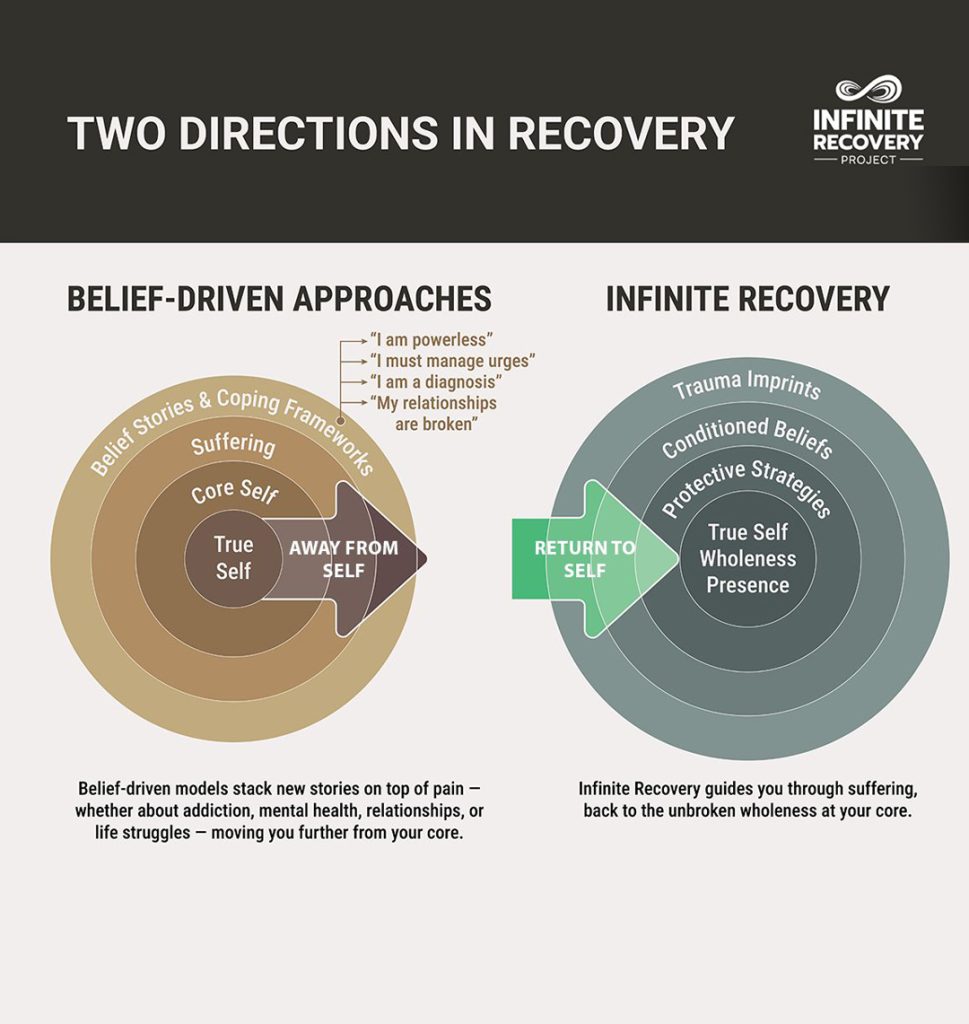
I’ve seen it over and over again: People who’ve been abstinent for years Who show up to every meeting. Who can recite the literature better than most therapists. And yet – they’re still ashamed, still compulsively helping others, still using food, work, or relationships to escape themselves. By all the usual metrics, they’re ‘in recovery’ and, nothing inside feels free….why is that? A 2022 study in Drug and Alcohol Dependence found: People who ‘complete’ residential treatment are not significantly more likely to experience long-term wellbeing – unless they also build a sense of connection and meaning. So when we keep measuring success by clean time, worksheets completed, or programs finished – we’re not measuring freedom, we’re measuring performance. That’s the danger – we confuse ‘recovery’ with ‘healing’ Recovery often means symptom management, where healing means integration. Recovery is about control, healing is about contact. Recovery keeps us in the story, healing helps us meet what’s underneath it. Even Thomas Insel, former head of the NIMH, said: ‘We spent $20 billion on mental health research and didn’t move the needle on outcomes.’ Why? Because we were looking for symptoms, not people. We were chasing outcomes, not wholeness. Bessel van der Kolk states: trauma isn’t healed through logic or language. It’s healed through embodied safety – through connection that reaches the parts of us beyond the mind. And yet so many recovery models stay entirely in the cognitive, step work, belief systems, identity labels, even evidence-based practices rarely measure aliveness – they just measure relapse. Yet abstinence doesn’t mean healed, retention doesn’t mean safe, and symptom suppression doesn’t mean freedom. Healing is different. It’s slower, deeper, and harder to measure. It doesn’t always look neat, but it changes people from the inside. Trauma informed is the new buzz-word, and a step in the right direction, but if it stays informational, not transformational, then it is no further use. If you want to see this modelled, look out for Wednesdays post. So here’s the question: What if some people ‘fail at recovery’ – not because they’re broken, but because their soul is calling them toward healing? P.S Are you joining our upcoming webinar series? Addiction as an Adaptive Intelligence: https://learning.infiniterecoveryproject.com/webinar   Get the book: https://www.amazon.com/dp/1068323302

Scroll to Top