

What if recovery and healing are pulling us in opposite directions?
I’ve seen it over and over again:
People who’ve been abstinent for years
Who show up to every meeting.
Who can recite the literature better than most therapists.
And yet – they’re still ashamed, still compulsively helping others, still using food, work, or relationships to escape themselves.
By all the usual metrics, they’re ‘in recovery’ and, nothing inside feels free….why is that?
A 2022 study in Drug and Alcohol Dependence found:
People who ‘complete’ residential treatment are not significantly more likely to experience long-term wellbeing – unless they also build a sense of connection and meaning.
So when we keep measuring success by clean time, worksheets completed, or programs finished – we’re not measuring freedom, we’re measuring performance.
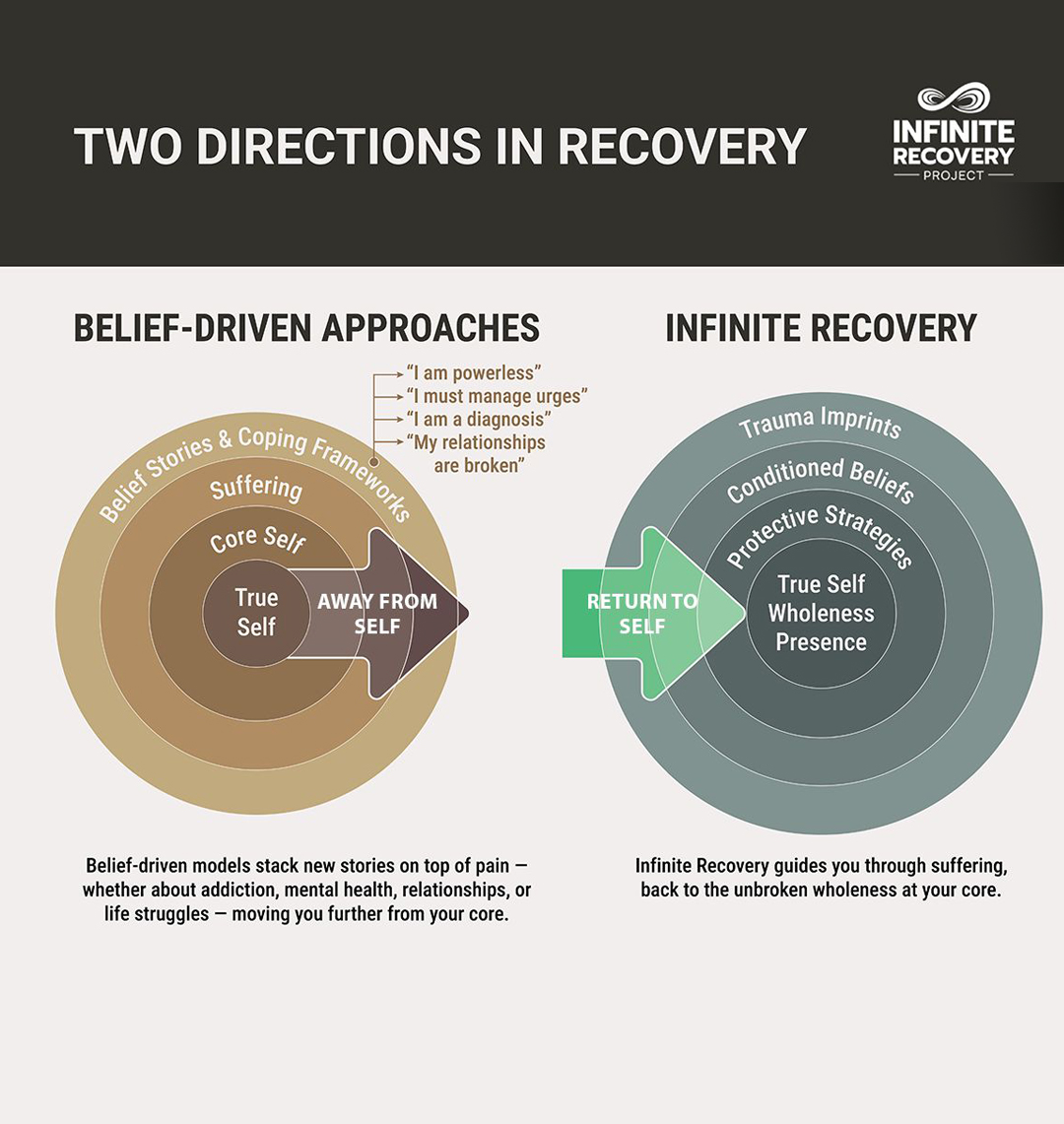
That’s the danger – we confuse ‘recovery’ with ‘healing’
Recovery often means symptom management, where healing means integration.
Recovery is about control, healing is about contact.
Recovery keeps us in the story, healing helps us meet what’s underneath it.
Even Thomas Insel, former head of the NIMH, said:
‘We spent $20 billion on mental health research and didn’t move the needle on outcomes.’
Why? Because we were looking for symptoms, not people. We were chasing outcomes, not wholeness.
Bessel van der Kolk states: trauma isn’t healed through logic or language. It’s healed through embodied safety – through connection that reaches the parts of us beyond the mind.
And yet so many recovery models stay entirely in the cognitive, step work, belief systems, identity labels, even evidence-based practices rarely measure aliveness – they just measure relapse.
Yet abstinence doesn’t mean healed, retention doesn’t mean safe, and symptom suppression doesn’t mean freedom.
Healing is different. It’s slower, deeper, and harder to measure. It doesn’t always look neat, but it changes people from the inside.
Trauma informed is the new buzz-word, and a step in the right direction, but if it stays informational, not transformational, then it is no further use.
If you want to see this modelled, look out for Wednesdays post.
So here’s the question:
What if some people ‘fail at recovery’ – not because they’re broken, but because their soul is calling them toward healing?
P.S Are you joining our upcoming webinar series? Addiction as an Adaptive Intelligence:
https://learning.infiniterecoveryproject.com/webinar
Get the book: https://www.amazon.com/dp/1068323302