

You Cannot Learn a Model of Health – Part 4 (Adopting a Model of Health in Addiction Treatment)
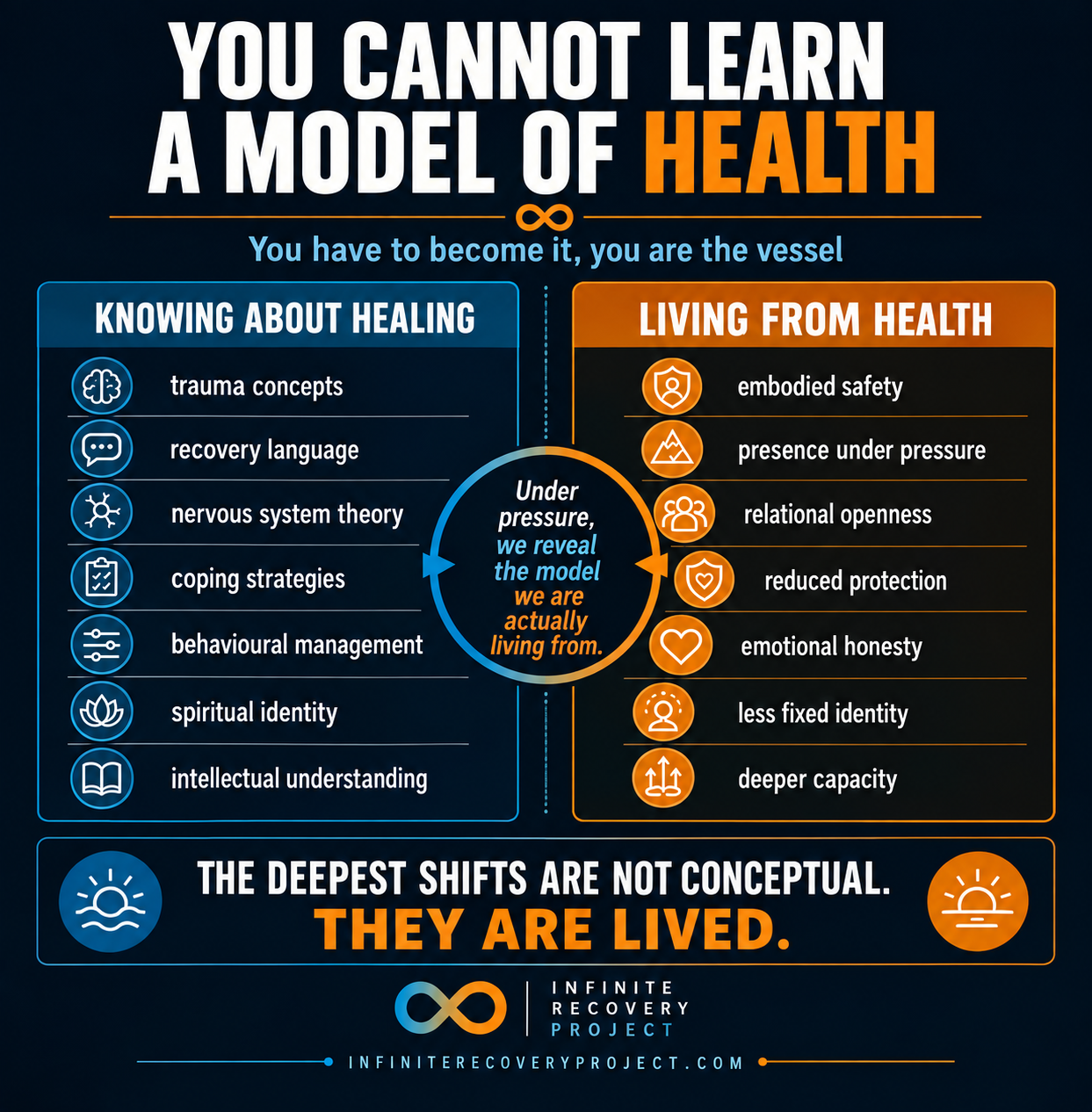
One of the biggest misunderstandings in recovery, therapy, and mental health work is the belief that health is primarily something we intellectually learn
This isn’t true
A person can study trauma, attachment, neuroscience, nervous system regulation, psychology, spirituality, addiction, recovery theory, and human behaviour for decades…
…and still fundamentally organise around fear, protection, control, shame, identity, hypervigilance, performance, or emotional avoidance underneath
This is why information alone doesn’t transforms people
The mind can understand something long before the nervous system, relationships, and lived experience actually embody it
Research across attachment theory, interpersonal neurobiology, and trauma increasingly points toward the importance of relational experience, embodied safety, co-regulation, and emotional integration rather than insight alone (Siegel, 2012; Schore, 2003)
Human beings do not heal purely through concepts
We heal relationally
Experientially
Embodied
Under pressure
In contact with life itself
This becomes especially visible in relationships
Someone may speak beautifully about healing, awareness, regulation, recovery, or spirituality…
then become defensive, reactive, emotionally collapsed, controlling, avoidant, or dysregulated under intimacy, criticism, uncertainty, conflict, shame, rejection, or vulnerability
That is not failure, it reveals that healing is deeper than intellectual understanding
Under pressure, we reveal the model we are actually living from
This is also where spirituality and awakening begin to matter in a very practical sense
Not as belief systems
Not as spiritual performance
Not as bypassing pain
But through the gradual recognition that much of what we experience as “self” is organised through conditioning, memory, adaptation, protection, and survival learning
At deeper levels of healing, identity itself often starts becoming less fixed
There is more openness
More honesty
More flexibility
More relational capacity
Less compulsive self-protection
Less need to perform
Less need to become someone
The psychologist Carl Rogers spoke about trusting the ‘forward-moving tendency of the human organism’ toward growth and integration
That tendency already exists within people
Health is not something an expert installs into a broken person
It is something gradually uncovered when the conditions maintaining protection begin to soften
That is why a true model of health cannot simply be memorised, copied, or professionally performed
It has to become lived
And once someone genuinely begins experiencing human beings through that lens, it becomes impossible to return to seeing people primarily as pathology, disorder, or chronic defect underneath
Not because suffering disappears
Because the meaning of suffering changes completely