

Recovery Can Become Another Adaptation – Post 3 (Adopting a Model of Health in Addiction Treatment)
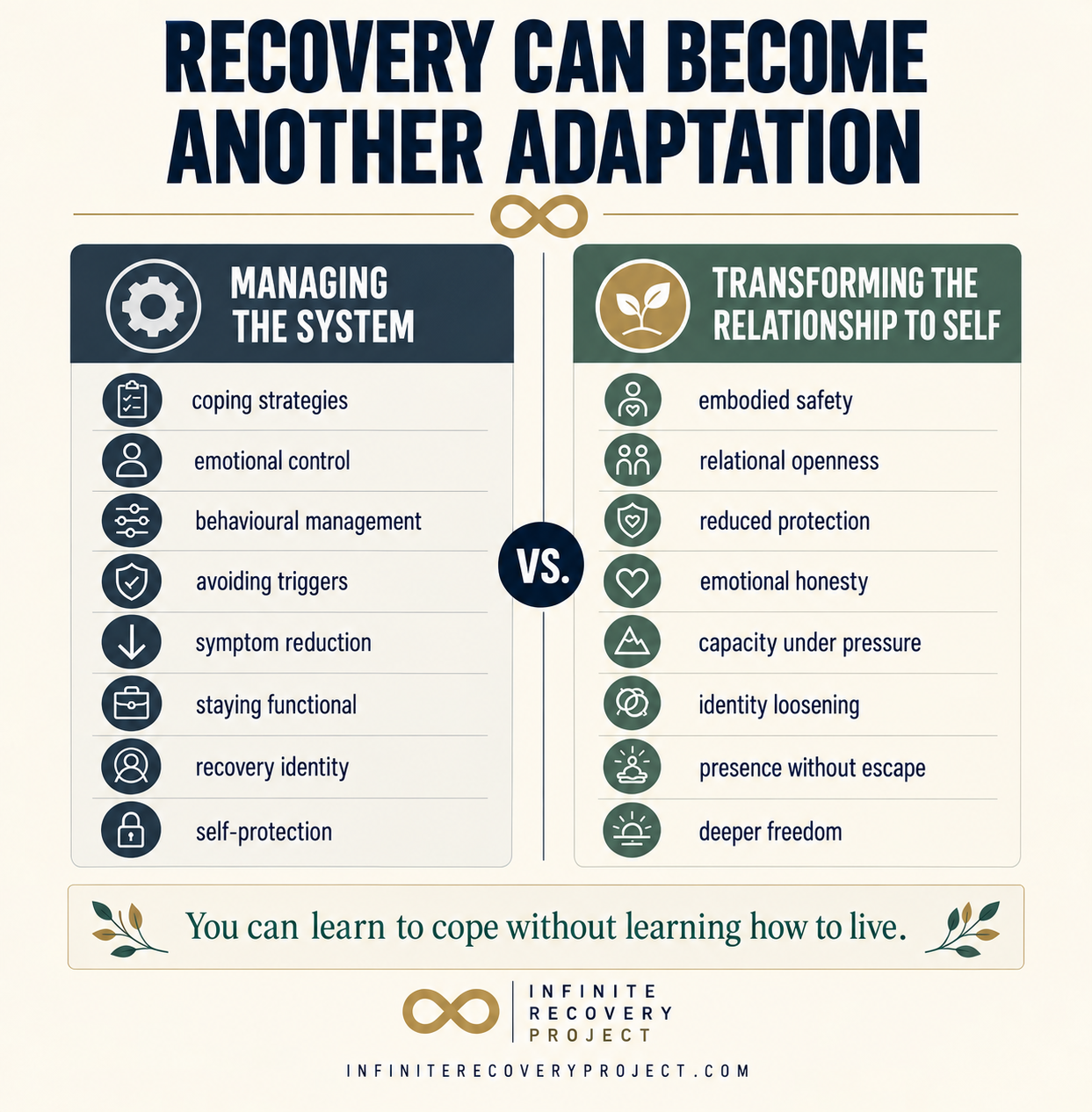
One of the more difficult conversations in recovery is recognising that sometimes the adaptation does not disappear
It changes form
A person may stop drinking, stop using, stop acting out, stop collapsing…
while still organising their life around fear, control, protection, shame, hypervigilance, performance, emotional suppression, or identity
From the outside, it can look like healing
Inside, the system may still be trying to survive
This is why stopping a behaviour is not always the same thing as freedom
And why coping is not the same thing as healing
Many people become highly skilled at
• managing themselves
• controlling impulses
• avoiding triggers
• performing recovery
• monitoring behaviour
• suppressing emotion
• staying functional
• becoming the good recovered person
But underneath, the nervous system may still not feel deeply safe
This becomes especially visible in relationship
Someone may appear calm and regulated alone, then become reactive under intimacy, criticism, uncertainty, vulnerability, conflict, rejection, or loss
Why?
Because real healing is not only behavioural
It is relational
It changes the relationship a person has with themselves, with emotion, with uncertainty, with others, and with life itself
Research across attachment theory, trauma, and nervous system science increasingly shows that long-term emotional patterns are shaped relationally and expressed relationally. Human beings do not regulate in isolation
That is why genuine regulation is not simply a technique
It emerges through increased safety, honesty, embodiment, connection, relational capacity, and reduced need for protection
This is also where spirituality and awakening begin to matter in a very practical way
Not as bypassing
Not as positive thinking
Not as becoming spiritually identified
But through recognising that much of what we call identity is itself organised around adaptation and protection
The psychologist Carl Rogers wrote:
‘The curious paradox is that when I accept myself just as I am, then I can change.’
Real healing often begins there
Not in becoming a better identity
But in no longer needing to organise life around defence in the same way
Recovery can absolutely save lives
But if recovery itself becomes another structure built around fear, self-monitoring, performance, or identity protection, the deeper freedom many people are longing for may still remain out of reach
—–
If you or your organisation would like to learn more about Infinite Recovery a model of health for addiction treatment, send me a DM.